Jul 07 2026.
views 9By Hafsa Rizvi
Try something for me. The next time you find yourself waiting, whether for your food to arrive, for a friend who is running late, or for the kettle to finish boiling, just wait. No phone. No podcast. No scroll. Just you and the moment.
If the idea of that makes you mildly uncomfortable, you are already inside the story this article is telling.
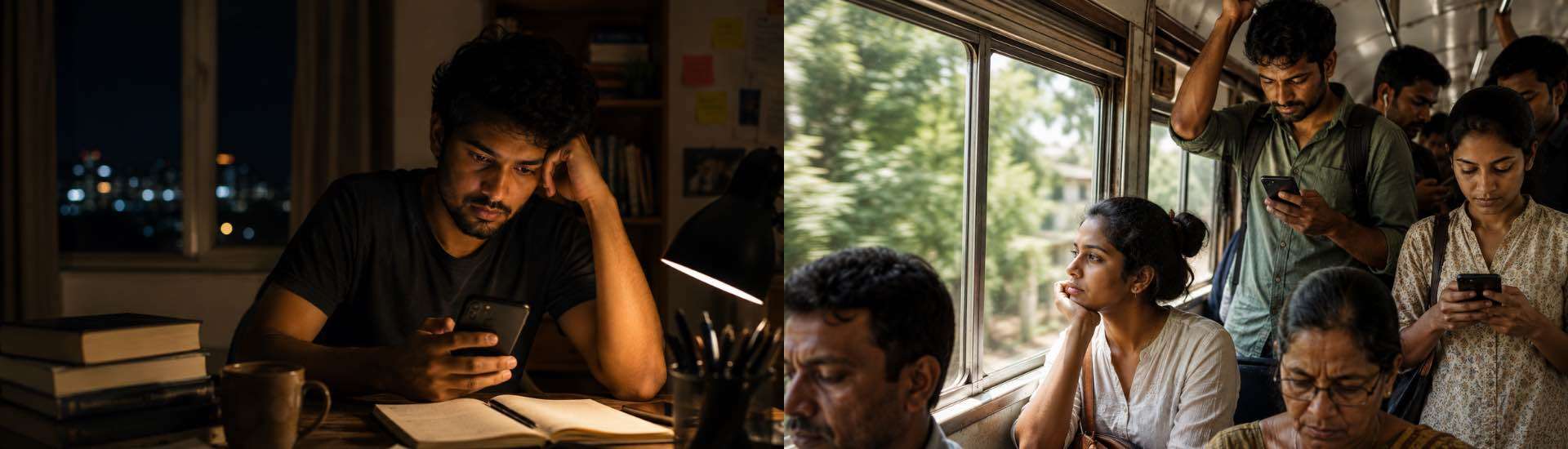
Something has shifted in the way we move through ordinary life. The quiet moments that used to simply exist, those small in-between spaces of standing in a queue, riding a bus, lying awake for two minutes before sleep, have almost entirely disappeared. Not because our lives have become more exciting. But because we have filled every available gap with a screen. And we have become so accustomed to that constant input that the absence of it now feels wrong. We are, slowly and without fully noticing, losing the ability to be bored.
The Numbers Behind the Feeling
This is not a feeling. It is a measurable shift in human behaviour and brain function.
In 2015, the average social media user could focus on a single post for 12 seconds. By 2025, that figure had dropped to just over 8 seconds. Teenage users now switch between apps every 44 seconds, compared to every two and a half minutes a decade ago. That is not just a statistic about phones. It is a picture of a mind that has been trained, repeatedly and relentlessly, to expect something new before the current thing has finished.
Young adults between 18 and 24 now report an average of over 12 hours of daily screen time. Twelve hours. That is more waking hours spent looking at a screen than doing almost anything else in a day. And within that time, the brain is not resting or even fully engaging. It is bouncing. Refreshing. Seeking the next thing before the current thing has had a chance to settle.
Research by Dr Gloria Mark found that as attention spans shrink, perceived stress levels and heart rates rise. The constant habit of checking creates a state she calls continuous partial attention, where the mind is never fully present anywhere. Not at dinner. Not in a conversation. Not even in the quiet moments we still technically have.
Why Boredom Was Never the Enemy
Boredom is not a problem to be solved. It is a signal, and a useful one. When the brain stops being entertained, something genuinely valuable begins to happen.
When we are bored, the brain is more likely to enter what neuroscientists call the default mode network, the system responsible for mind wandering and daydreaming. This state allows us to explore new ideas, make unexpected connections, and arrive at the kind of creative breakthroughs that focused, task-driven thinking rarely produces.
Studies show that people who score highly in what psychologists call positive constructive daydreaming solve insight puzzles faster and generate more original ideas. Mind wandering strengthens memory, supports emotional regulation, and allows the brain to run what researchers describe as low-risk simulations about future decisions.
In plain language, the thoughts that arrive when you stare out of a window and let your mind drift are not wasted thoughts. They are often your best ones. The shower revelation. The solution that came on a long walk. The idea that arrived not when you were trying but when you briefly stopped.
Research specifically studying boredom and creativity found that people who experienced boring activities before a creative task consistently outperformed those who had not. When boredom is followed by unstructured thinking, the imagination fills the gap, and it tends to fill it productively.
We are not just scrolling away discomfort. We are scrolling away the very mental state that produces our most interesting and original thinking.
What the Algorithm Understands About You
The reason silence now feels strange is not an accident. It is, in many ways, a design outcome.
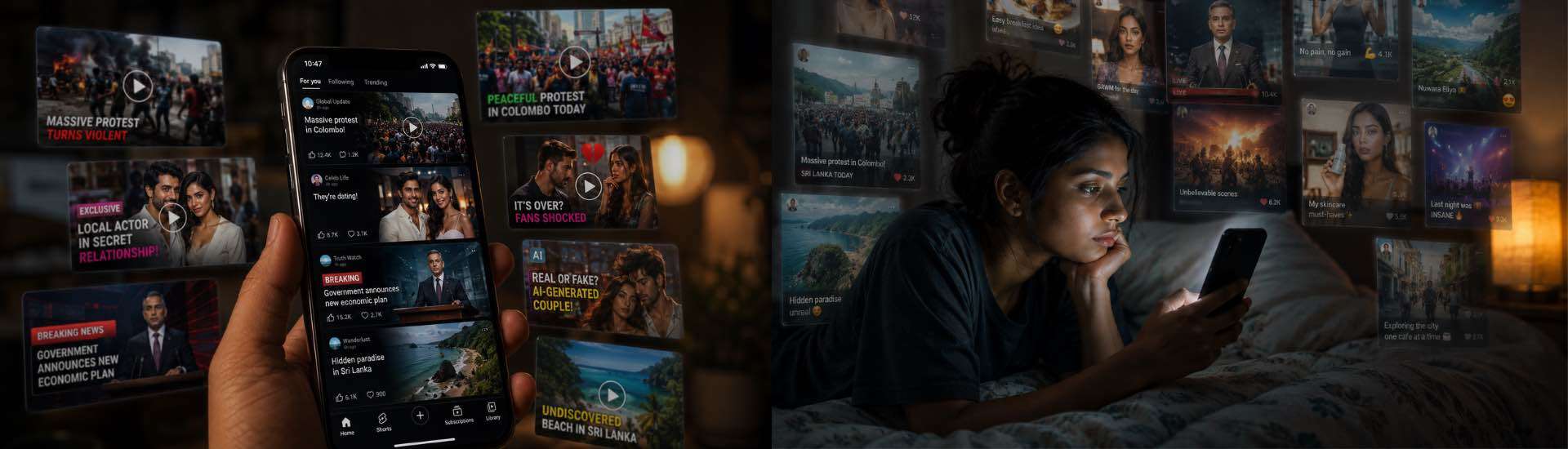
Every major social platform is built around a single goal: to keep you on it for as long as possible. The infinite scroll was not created because it was good for you. It was created because it removes the natural stopping point. A physical newspaper ends. A social feed never does.
Regular exposure to short-form content has been linked to a 39% decrease in deep reading habits over the past decade. Exposure to short videos before studying has been shown to reduce students' ability to focus during reading by 31%. More than half of people in a 2025 study admitted they skip videos longer than 60 seconds, even on topics that genuinely interest them.
The algorithm did not make us less patient. But it has certainly learned to exploit our impatience, reward it, and deepen it. Every time you swipe before a video ends, you are teaching the machine what to show you next. And what it learns is that you need things faster, shorter, and more stimulating than what came before.
Research published in 2026 confirmed that people who strongly dislike boredom use their smartphones significantly more and experience boredom more intensely as a result. The act of escaping boredom through a phone does not actually reduce it. It increases sensitivity to it, creating a cycle where the phone becomes the only thing that feels like relief, even as it makes the original discomfort worse.
The Quiet Things We Are Losing
Think about what boredom used to produce, before we had a device in our pocket capable of ending it instantly.
Children who were bored invented games. They built things. They sat in trees and came down with stories. Adults who were bored wrote letters, started diaries, talked to strangers on trains, stared at ceilings and worked through problems they had been avoiding.
None of that sounds dramatic. But collectively, those idle hours were when enormous amounts of human creativity, reflection, and self-knowledge were born. The uncomfortable truth is that many of the people we admire most, in art, science, literature, and innovation, did their best thinking in a world where boredom was unavoidable, and silence was simply part of the day.
We have removed that. And we have done it so completely and so quickly that most people have not yet noticed what went with it.
Research on teenage screen use found that children who spend more than seven hours a day on screens show measurable thinning of the cortex, the area of the brain responsible for processing information. This points not just to behavioural changes but to potential structural ones. We are not simply choosing to use our brains differently. We may be reshaping them.
Nobody Is Coming to Rescue Your Attention
It would be comforting to end this piece by telling you that the technology companies are working on the problem. That somewhere in a glass-walled office, engineers are designing features to give your brain more rest and your mind more room. They are not. At least, not in any meaningful way.
The same platforms whose products have driven the collapse of focused attention also profit from that collapse every single day. The more fragmented your attention becomes, the more likely you are to need stimulation, and the more likely you are to return to the feed that provides it. The incentive structure does not reward your stillness. Which means the only person who can actually do anything about this is you.
Not in a drastic, delete-everything way. But in small, deliberate, genuinely courageous ways. Leaving your phone in another room for one meal. Walking somewhere without earphones. Allowing yourself to be bored in a waiting room without immediately reaching for a distraction. Sitting with a thought long enough to find out where it leads.
These are not grand gestures. But they are acts of genuine resistance against a system that profits from your inability to sit still.
The Thought Nobody Wants to Have
If silence now feels unbearable, if being alone with your own thoughts for five minutes produces a kind of restless anxiety, what does that tell us about the relationship we have built with our own minds?
Because a mind that cannot tolerate boredom is a mind that cannot tolerate itself. And that is a far more serious problem than screen time statistics can fully capture.
The problem is not that technology keeps us endlessly entertained. That part is impressive, genuinely. The problem is that we have stopped practising the quiet. We have stopped trusting that our own thoughts, the ones that arrive in the in-between moments, the ones that do not come with a notification, are worth waiting for.
Perhaps the most radical thing any of us could do in 2026 is simply sit with ourselves for a little while and see what comes.











0 Comments