May 15 2026.
views 8By Paul Topping
Seven of us set off to Trincomalee, on the east coast of Sri Lanka facing the Indian Ocean. There are a number of targets for me beyond the team’s swimming, walking, eating and chilling list. There is lots of colourful, and some dark, history in this town.
The first visit is to the Commonwealth War Graves, five minutes from our hotel. The aged, but very well-operated, Trinco Blu Hotel, with the executive rooms facing the sea.
At the graves I walk the full rows of the three hundred gravestones, reading out the odd name. So many different nationalities. The two young children with us find it fascinating, and we are there for an hour. “Lest we forget.”
We head into Fort Frederick. The first stop is to buy tickets to walk the Garrison hill fort . Some conflicting messages on entry price of foreigners . Twenty two years living in the country doesn’t help me .
The girls notice the deer population who, unlike us, are hiding from the sun under the many trees. There is a stunning lookout position over the sea and cliff face, surrounded by parts of the old fort wall. This was a major fort, capable of housing a thousand military personnel at its peak. It is a bit dilapidated now, with lots of abandoned buildings, but you can still see its sense and purpose.
Overlooking one of the largest natural harbours and bays in the world it was a key naval asset through much of the town’s history. By World War Two it had become more vulnerable, especially from air attack.
On a previous visit to Trinco, I was travelling with a retired major from the Sri Lankan Armoured Vehicle Division. He made the call and we got into the military site. A smart, young major greeted us and we were shown the 30-plus tanks in his extensive shed. To me, they looked like museum pieces from after the Second World War.
Trinco is a military town, perhaps going back over two thousand years. Its biggest asset is said to be one of the largest natural enclosed harbours in the world, with deep water facilities. References to this harbour have come from Horatio Nelson, Winston Churchill, William Pitt and explorer Samuel Baker, all referring to its size, location and as a safe haven.
Trinco was a major strategic location for the Portuguese, Dutch and British colonisers. They all fortified it well.
Even back in the 1920s, the British expanded the Trinco fortifications. We finish the fort tour at the impressive Koneswaram Temple. The walk in bare feet in the mid-afternoon sun burns the bottom of our feet. A policewoman rushes over with water for us.
Thank God that in 1942, after a tip-off, most of the British fleet had already moved from Trinco and gone to hide in the Maldives. The Japanese sank only a limited number of British naval vessels, one however was the aircraft carrier HMS Hermes . With no planes on its deck Captain Richard Onslow and three hundred others reportedly went down with the ship.
Trinco is one of the oldest port cities in Asia. The town itself today, however, is quite drab but clean. A town with an outer population of around 440,000 has a remarkably mixed population, with Muslim, Tamil and Sinhalese communities all strongly represented. It remains one of the most diverse multi-ethnic regions of Sri Lanka.
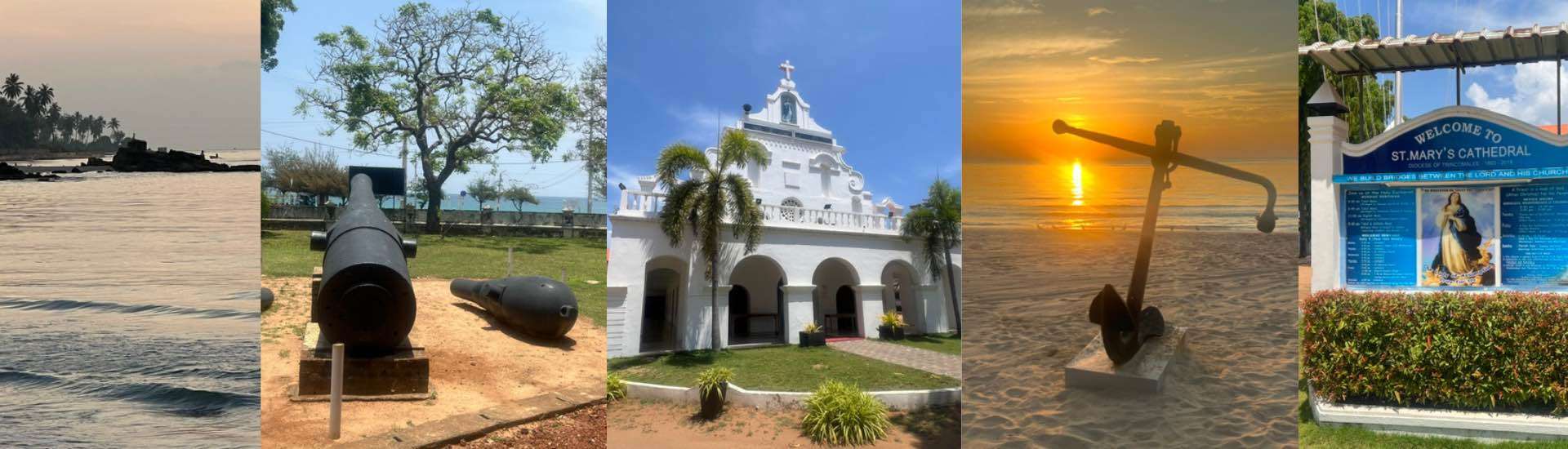
We target two naval museums . The first is at Navy HQ. To enter, we all need passports, not phone copies but the actual originals. We leave .The second naval museum is an old governor’s house, nicely renovated with many rooms to cover. Our guide is enthusiastic and passionate about telling the stories. Unusual for Sri Lanka. Well worth the trip. Afterwards, we head back to the great beach in front of the hotel.The sunsets are amazing .
There is also a dark period in the history of this town, especially between 1983 and 2009 during the civil war years. Ethnic violence and massacres were common. Tit-for-tat killings, attacks on mosques and years of conflict resulted in thousands of deaths and many human rights cases.
We get out towards Marble Bay and swim off an idyllic bay with a cute bar, all managed by the navy.
It is clear that lots has changed in the last few decades in Trinco .The city feels quiet, and the people we meet are friendly, helpful and modest.






0 Comments