
Oct 20 2026.
views 0By Rihaab Mowlana
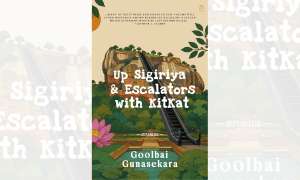
There is a particular pleasure in reading someone who can laugh at herself without rushing to tidy up the embarrassment afterwards. In Up Sigiriya & Escalators with KitKat, Goolbai Gunasekara finds comedy in family life, childhood memories and the indignities of growing older, drawing on ordinary situations that often reveal rather more about us than we intend.
The opening story sets the tone. Having visited Sigiriya several times, Gunasekara has little intention of climbing beyond the Lion's Paw until she promises her granddaughter, KitKat, that she will accompany her to the top. KitKat remembers promises rather inconveniently well, leaving her grandmother committed to a climb she had not quite bargained for.
As Gunasekara struggles upwards, she encounters fellow tourists and attempts to preserve some semblance of dignity, while KitKat is absorbed in exploring the ancient site. The humour lies in the contrast between the grandmother's weary familiarity and the child's enthusiasm, with Gunasekara's willingness to make herself the joke keeping the story affectionate rather than tiresome.
That self-deprecating humour returns in The Tortoise, the Hare and Escalators, where the indignities of modern travel provide ample material. As younger travellers navigate escalators with effortless confidence, Gunasekara finds herself struggling to keep up. Her determination to maintain her dignity makes the situation funnier than any elaborate punchline could.
In Winning and Losing Then and Now, a card game with KitKat becomes a domestic debate about fairness. The granddaughter routinely wins, prompting her mother to question whether the victories are entirely deserved. Gunasekara defends the child, while her daughter worries about the consequences of letting her win too easily. It is a small family exchange, but one that captures the competing instincts of grandparents and parents without making either side entirely right.
A more revealing story is Learning to Dance a Generation Ago, in which Gunasekara recalls her teenage years, when ballroom dancing was considered an essential social skill and attending a mixed party at sixteen was a matter of considerable importance.
The girls are desperate to learn the steps, but their parents are less enthusiastic. Their fathers are more interested in school reports than the foxtrot, while their mothers worry about the romantic possibilities. The girls improvise, practising at school and learning from friends who have attended dance classes.
The story becomes more interesting towards the end, when Gunasekara acknowledges that she and her friends were, by and large, happy despite their parents' restrictions. She then catches herself repeating the same pattern with her own granddaughter, telling the child that others may do certain things, but she cannot. The narrator, who once resented parental rules, has become the adult imposing them. Her willingness to expose that contradiction gives the story its bite.
The collection's nostalgic appeal is unmistakable. Its references to older customs, family expectations and changing social habits evoke a Ceylon that younger readers may know chiefly through family recollections. Arthur C. Clarke's endorsement praises the stories for recalling a Ceylon that might otherwise be lost beyond recall.
But nostalgia can be a double-edged tool. It preserves details that might otherwise disappear, yet it can encourage an overly affectionate view of the past. Gunasekara's strongest stories allow contradictions to remain visible: parents may have had their reasons, but restrictions were still frustrating, and the desire for independence was hardly unreasonable.
Not every recollection is equally compelling. Some comparisons between past and present depend heavily on the pleasure of recognition, and readers unfamiliar with the author's social world may find themselves at a distance from the humour. The stories are rooted in particular assumptions about family life, class and respectability, giving them historical texture without always offering a broader observation.
Gunasekara is at her best, however, when she lets an incident speak for itself. A promise to climb Sigiriya becomes an exhausting expedition; a card game becomes a domestic dispute; learning to dance becomes a negotiation over parental authority.
Up Sigiriya & Escalators with KitKat is an affectionate collection with a keen eye for human foibles, though its stories are most persuasive when they move beyond reminiscence and offer a sharper perspective. Its most memorable moments reveal the contradictions beneath changing customs, reminding us that growing older does not exempt us from repeating the habits we once questioned. Sometimes, it merely gives us a new position from which to defend them.









0 Comments