Oct 13 2026.
views 53By Rihaab Mowlana
I was still in primary school when Sri Lanka’s civil war was raging. I wasn’t living at the centre of the conflict, but even from a distance, its effects were felt. I remember the security checks, the atmosphere of uncertainty and the ways the war filtered into everyday life, even for a child too young to understand what had brought the country to this point. I knew what it felt like to grow up in that environment, but I didn’t yet understand the history behind it.
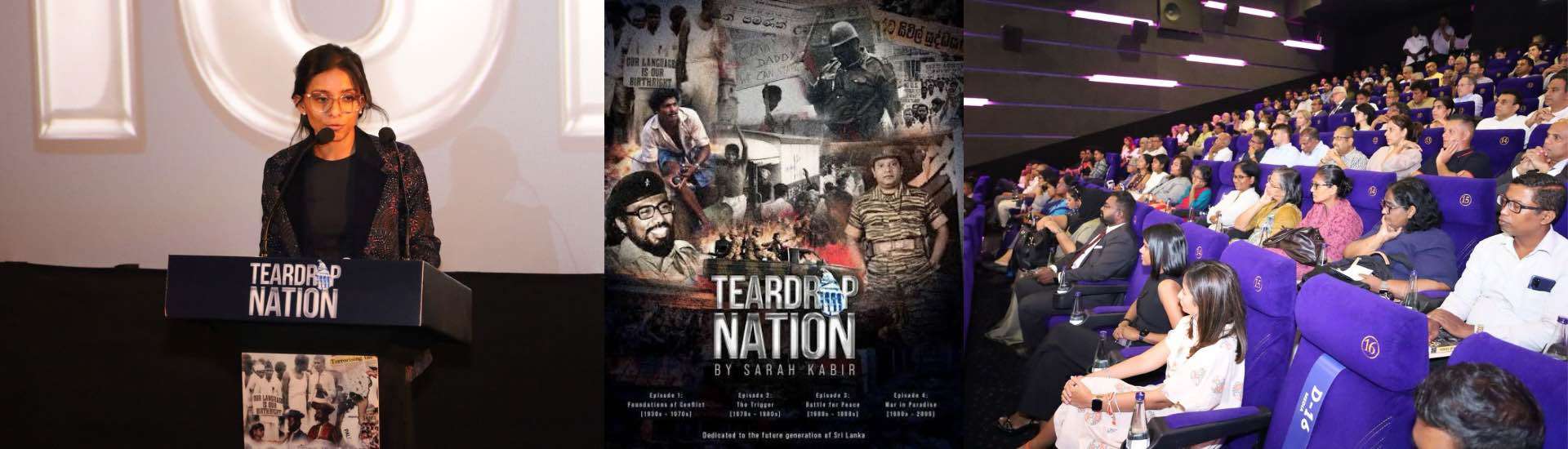
When I was invited to a preview screening of the first episode of Teardrop Nation, I was curious to see how it would tell a story I remembered from the edges of my childhood, but had been too young to understand. The conflict’s place in everyday life was familiar to me, but the political decisions, historical developments and deepening divisions behind them were not. Here was an opportunity to understand the history behind the memories.
Titled The Seeds We Sow, the opening episode takes us back to a period long before the war became part of our everyday vocabulary, examining the developments that shaped the country’s political and social divisions. Its starting point is important because the history of a conflict cannot be understood simply by beginning where the violence becomes impossible to ignore. There is a longer story behind it, one that requires us to look at the decisions, attitudes and divisions that took shape over time.
I have always believed that we cannot move forward as a country without being willing to acknowledge our past, the good, the bad and the ugly. That does not mean dwelling in it indefinitely or assigning blame without understanding the circumstances. It means being honest about what happened, even when that honesty challenges the versions of history we have grown comfortable with.
For many of us, our understanding of Sri Lanka’s recent history comes in fragments. We learn some things in school, hear others from our families and absorb still more through the political conversations that surround us. What we remember personally may be very different from what someone else remembers, particularly when our experiences of the same period have been shaped by different circumstances. We can grow up in the same country and carry very different understandings of how it became what it is today.
This is where Teardrop Nation becomes particularly relevant.
Developed over six years by Project 72, with Sarah Kabir as Project Director, the four-part documentary series examines Sri Lanka’s post-independence political and conflict history. The first episode establishes the foundations, while the subsequent instalments follow the developments that led to the conflict and its eventual end in 2009. Having watched only the opening episode, I cannot speak for the entire series, but I appreciated its effort to make a complicated history accessible without sugarcoating the subject.
The episode brings together the voices of politicians, journalists, historians, educators and members of politicians’ families, allowing different perspectives to contribute to the story. What I appreciated was how easy it was to follow, even while dealing with material that is politically and emotionally complicated. It did not leave me feeling that the subject had been simplified to the point of losing its meaning.
Instead, I found myself learning things I had not fully understood before and reconsidering aspects of history I had previously taken for granted. That, to me, is one of the most valuable things a documentary can do. It can give us information, but it can also make us recognise how much we still have to learn.
I was particularly reminded that the people who shape history are human beings, too. Political leaders make decisions, and those decisions can have consequences that extend far beyond their own lifetimes. Recognising that leaders are human does not absolve them of responsibility, nor does it mean treating every decision or mistake as equally consequential. It simply asks us to examine the people behind the politics rather than reducing complicated histories to convenient characters.
At the screening, Sarah spoke about the six years of research and production that went into the series, as well as the difficulties of pursuing reconciliation in a country where acknowledging the past remains challenging. The research involved consultations with more than 40 academics, 33 high-level interviews and the collection of over 1,500 archival items. The scale of that undertaking speaks to the work required to bring together a history that spans generations and encompasses experiences that cannot all be captured in a single account. Sarah described the purpose of the series in one word: “non-recurrence”.
It is an important distinction. Remembering what happened is not the same as understanding why it happened, and understanding it is not the same as learning from it. A country can continue to commemorate its past while remaining reluctant to examine the decisions, prejudices and failures that helped shape it. Without that examination, there is a risk that history becomes something we revisit through familiar arguments rather than something we genuinely learn from.
During her remarks, Sarah spoke about the decades of discrimination that preceded the decades of war, emphasising that Sri Lanka did not arrive at conflict overnight. It is a reminder that the conditions leading to violence often develop over a much longer period, through political and social choices whose consequences may become apparent only later.
This is why looking at the roots matters. If we focus only on the years of armed conflict, we risk missing the longer history that preceded it. If we look only at the suffering caused by war without examining the circumstances that led to it, we leave important questions unanswered.
None of this makes confronting the past straightforward. History is rarely black and white, as Sarah acknowledged, and a series of this nature cannot capture every experience or resolve every disagreement. People have different memories, different perspectives and different reasons for interpreting events as they do. The value lies in being willing to encounter those perspectives, question our assumptions and consider information that may challenge what we have always believed.
I was also struck by Sarah’s acknowledgement that she had not lived through more than half of the decades covered by the series. She spoke about trying to tell the story through the eyes, minds and hearts of those who had experienced it. There is an important recognition in that, because telling a country’s history requires more than assembling dates and political events. It requires an awareness that behind those events are people whose lives were shaped by decisions they may never have had the power to influence.
I finished the episode feeling both hopeful and troubled. Hopeful because a project of this scale is making an effort to bring our history to a wider audience, particularly younger people who deserve the opportunity to understand the country they have inherited. Troubled because the need for such a project also reminds us how difficult it remains for us to confront our past honestly.
My own memories of the war are not memories of living at its centre. They are memories of being a child in a country where the effects of the conflict reached into everyday life, even for those who were not directly experiencing the fighting. At the time, I could not have understood the political decisions or years of tension behind that atmosphere. I simply knew what it felt like to grow up with it.
Watching The Seeds We Sow brought home the difference between remembering a period and understanding its history. The two are connected, but they are not interchangeable. Sometimes, understanding requires us to return to the past as adults, ask questions we were too young to ask at the time and accept that the answers may be more complicated than we expected.
I am glad Teardrop Nation is creating space for that process. Looking back at our history is uncomfortable, particularly when it means questioning the people we trusted, the decisions we defended or the things we chose not to see. But if we are to understand how Sri Lanka reached this point, we have to be willing to ask those questions.
We cannot change what happened, and acknowledging the past cannot undo the suffering of those who lived through it. What we can do is decide what we take from it, whether we continue passing down selective memories and inherited divisions or make a more honest effort to understand how we arrived here.
The first episode is only the beginning, and I look forward to seeing how the remaining instalments develop the story. More than anything, I hope the series reaches people who might not ordinarily seek out a documentary about political history, including those who were children when the conflict was part of the world around them.
We may not all have experienced history in the same way, but we have all inherited the country it helped shape. Understanding that inheritance means being willing to look beyond what we remember, question what we think we know and confront the parts of our past that are easier to leave unexamined.








0 Comments