Jul 22 2026.
views 285I’ve known Lilanka Boteju for a long time, and if there’s one word I’d use to describe her, it’s headstrong in the best possible way. She knows what she wants, she knows what she’s talking about, and she’s never been afraid to brew her own path… quite literally, in this case!
It makes me incredibly proud to see her grow from strength to strength and now take her years of knowledge and experience in the tea industry and pour it all into The Tea Herald. In a country where we drink tea every day but perhaps don’t know enough about the incredible story behind our cup, Leelanka is making tea something to understand, experience and appreciate. I can’t wait to see where this new journey takes her, because knowing Leelanka, she’s only just getting started.
You can also catch her on Hi TV, where she brings her knowledge and personality to the screen with Sri Lankan Understanding. So, put the kettle on this week on the Buzz; we talk tea, ambition, history and everything that’s brewing in the world of Lila.
1. Lilanka, we Sri Lankans drink tea like it’s practically a constitutional right, but how much do we actually know about what’s in our cup?
We know very little. Most people know black tea and green tea, and now Matcha is trending. But ask them if they have tried a Single Estate Nuwara Eliya tea, a Seasonal Flush Uva tea or what fruit flavours an Earl Grey tea, they will have no idea what those are. They will be rushing to hike the Pekoe trail but will not know what Pekoe means.
2. You’ve spent over 16 years in the tea industry, working with names like Dilmah, Watawala and Wilmar. After all those years surrounded by tea, what made you say, “Right, now I need to start The Tea Herald”?
Honestly, last year was a very trying year both personally & professionally. You realise the glass ceiling is a slab, especially in traditional industries like tea. Having said that, there are people in the tea industry who have been very supportive in encouraging me to venture out on my own, and I am very grateful to them. I was toying with the idea of starting my own business for a few years but never got down to it. When I left my job in December, I realised it was my wake-up call to do what I knew I could because I have the experience and the skill to do it. And I have always felt I have a calling in tea – it has followed me for over 16 years. Hence, I started Tea Herald.
3. What exactly does a Tea Herald do? Because I’m imagining someone dramatically announcing the arrival of a teapot, but tell us what the concept really means.
Ha ha, it is the dramatic announcement of all knowledge on tea. But actually, I used the term Herald because it is someone who announces important news that everyone should pay heed to. And tea is something that is part of our heritage, which we are quite ignorant about. As a tea-growing country, we are not brand ambassadors of our own tea, so how can we promote it to others? We want to be identified as a tourism hotspot and promote our own produce, but when it comes to tea, we can’t even brew a proper cup at most of our hospitality venues. The concept is to be that missing link – linking the product with the service so that people learn about tea and can offer an experience vs just a black tea with or without milk.
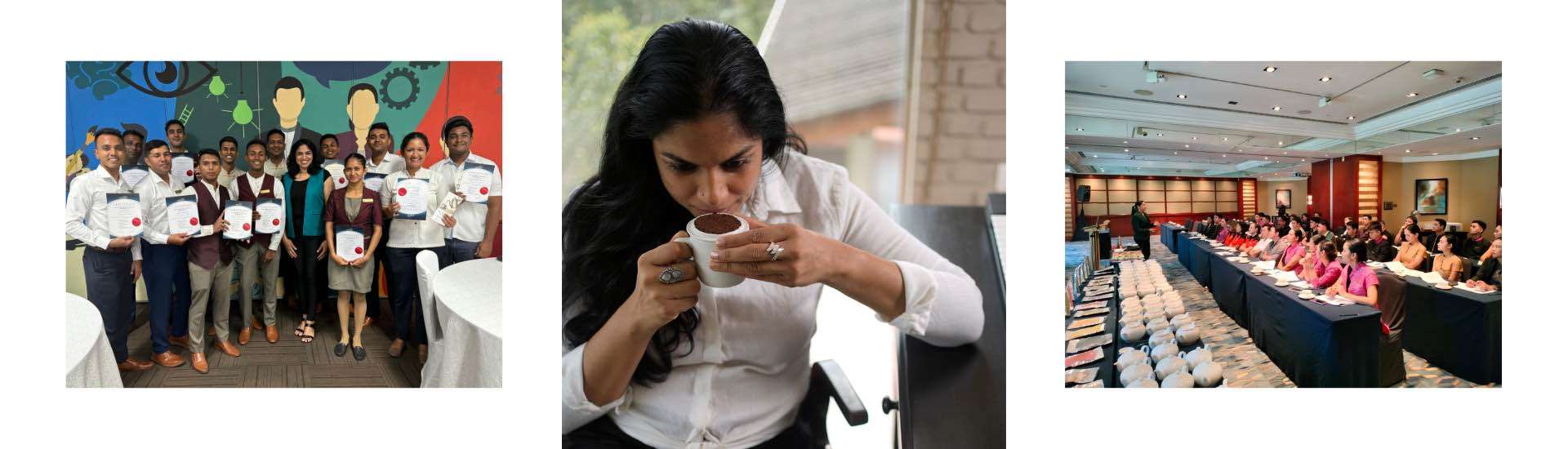
4. You’ve trained hospitality teams at Shangri-La properties across China, Singapore, the Philippines and Hong Kong. What do other countries understand about serving and appreciating tea that we Sri Lankans could learn from?
People in those countries have a healthy respect towards tea – especially in China, where tea is a culture and a huge component of their lives. They do not treat it as a commodity or something to be discarded. Sri Lankans have a very low opinion of tea, but they cannot live without it - it fuels the engines that run this country. Most of the high teas in the hotels are about the food – some are even serving iced coffee – there is hardly any focus on the tea or an experience surrounding it. Hotels overseas have themes, tea and food pairing and tea-based drinks, etc. These are all opportunities to build a tea culture in Sri Lanka if we implement them.
5. We proudly say “Ceylon Tea”, but do we truly understand why that name once carried such enormous prestige around the world and have we done enough to protect it?
No, we do not understand why Ceylon Tea was prestigious, and we have done very little to protect and promote that name. It is partly because we see colonisation in a very negative sense, and yes, the tea industry has its fair share of negative impact, especially in the treatment of the Malaiyagar Tamil Community. But it is also a heritage and a huge revenue earner for the country. We cannot discard tea and all aspects of it because it started as an oppressive colonial enterprise. If we value the tea we make, we can then elevate the industry and the people involved in it. Another issue is that we have been a bulk tea supplier for too long. The money is in value-added teas, and we need to start pushing that forward more. The current Middle East crisis is proving this point as our bulk tea sales are severely affected because of it.
6. Sri Lanka has seven distinct tea-growing regions across three elevations. If I put seven cups in front of the average Sri Lankan, could we actually taste the difference? What should we be looking for?
If you put the 7 distinct tea-growing regions, which are properly manufactured and brewed, the differences would be in taste and colour primarily, and yes, you can taste and see those differences.
7. Can you ruin a really good tea simply by brewing it badly? Give us the biggest tea crimes we are committing at home every single day.
Yes, you can! Biggest crimes committed daily – putting any amount of tea with any amount of boiling water. There is a water-to-tea ratio – this determines the final cup. Brewing it for too long – 5 minutes max for a black tea – brew it for longer, and you will be drinking a bitter brew like a kasaya. Storing open packets of tea next to spices and heat – tea absorbs moisture. Soon it will be like a Masala chai and not a black tea.
8. Milk first or tea first? Sugar acceptable? And how long should we actually brew a proper cup? Settle some national arguments for us, Lilanka.
Tea first and then milk. The milk first was done at a time when the cold porcelain could crack because of the hot tea. This is why you pre-warm your teapot and cups. Tea first and then add the milk according to the strength you wish. A black tea should be brewed for 3 – 5 minutes. To add milk, you would generally brew it for 5 minutes. But this depends on the tea as well – not every black tea should be had with milk. Sugar is up to individual preference. But to properly taste a tea and to understand it – have it plain. No milk and no sugar.
9. Tea has an extraordinary history involving colonialism, trade, the Opium Wars, Hong Kong and global politics. What is one story from tea’s history that completely surprised you when you first discovered it?
That Matcha tea was first made in China during the Tang and Song Dynasties, which was over 1000 years ago. This was later taken and fine-tuned by Japan.
10. The Sri Lankan tea industry didn’t just create an export; it shaped plantation communities, lifestyles, employment and even our railway system. Do you think we sometimes forget how deeply tea has shaped the Sri Lanka we know today?
Yes, we don’t realise how intricately woven into our lives tea is. The tea industry, which started just before the Industrial Revolution, brought with it an entire tea-drinking culture which we never had before. It reshaped our landscapes, our culture, transport and lifestyles in just over 150 years.
11. You speak about the commoditisation of tea and the battle between price and value. Has selling tea cheaply ultimately damaged the premium reputation that Ceylon Tea spent generations building?
Yes definitely. Trying to match low prices and play the bulk tea game has seriously undermined Ceylon tea because it was never a product built on low quality and a low price. We were raw material suppliers under the British. When we gained independence, that mindset did not shift except for a few brands that realised value addition is where the money is. But brand building is a long game, and many don’t know or don’t want to venture down that road. Hence, they prefer the quick ROI of selling bulk teas.
But we are unable to compete globally with countries like Rwanda and Kenya where tea grows on plateaus and can be easily harvested. Our hills do not allow for mechanisation so easily, and then again, one must ask, why are we chasing behind newer tea industries without capitalising and marketing our own? In China, there are teas being sold for Rs. 1 million a kilo or more. They have a market because the producer has a direct connection with the buyer. Like what Sir Thomas Lipton did – he bought the tea estates and sold directly to consumers. We need to change our model if we are to be more competitive globally and profitable locally.
12. We’re seeing coffee become an entire experience: speciality beans, baristas, tasting notes and beautiful cafés. Why haven’t we given tea the same glamour? Could premium tea culture become Sri Lanka’s next big lifestyle experience?
There definitely is potential for a premium tea culture in Sri Lanka, if Sri Lankans understand the value of tea. Currently, people will gladly pay Rs. 800 to Rs. 1800 for a coffee in a fancy café where the quality of the beans is not known, and yet they would be reluctant to spend even Rs. 400 on a cup of tea. If people knew the effort and skill required to manufacture that tea, they would be willing to pay a lot more. And if they knew the stories behind the tea, then they would understand why it can be glamorous.
13. Your first appreciation experience, “The Romance of Ceylon Tea,” explores history, manufacturing, taste profiles and brewing. If someone walks in thinking, “Tea is just tea,” what do you hope they’ll be saying when they walk out two hours later?
I hope people say, ‘Omg, I have been living under a rock. I definitely need to appreciate and try out more of our own teas.’
14. The event is deliberately intimate, with only 12 people. Why was it important to keep the experience so personal, and what can guests expect when they sit down at that table on July 28?
Tea has many facets to it. I want to be able to connect with each participant and explain why this is more than just a cup. A smaller group means we can discuss more and dive deeper together. Guests can expect a new perspective on tea through knowledge sharing, understanding how tea is made and tasting teas unlike they have before to appreciate how each one is unique and different, though they all come from one country.
15. Finally, I have to put the expert on the spot: if you could serve one perfect cup of Ceylon Tea to someone anywhere in the world, who would you serve it to, which tea would you choose, and what story would you tell them while they drank it?
Well, different people love different types of tea – so let me pick one of my favourite Ceylon teas. I would select a Nuwara Eliya tea from Pedro Estate and serve it to a British consumer. I would serve it hot and straight – no milk or sugar. A slice of lemon on the side should they wish to add it in. I would tell them about how the Duke of Edinburgh (Prince Philip, husband of Queen Elizabeth) visited Pedro Estate in 1954, accompanied by Sir Oliver E. Goonetilleke – Governor General of Ceylon, and how the Duke planted a few tea seedlings, and it is these that are still growing and producing these teas on the estate. That they, as British consumer, should be happy to be enjoying a royal brew from Sri Lanka (formerly Ceylon).









0 Comments