Mar 27 2026.
views 352By Paul Topping
The British occupation of Colombo created the heyday of Fort. It was a gateway to the British Empire, north, east and west. This area was once a walled fort with sea frontage. In 1870, the British destroyed the walls of the fort, as city and port expansion were key to growth. Today, the port ranks in the top thirty ports worldwide. The Fort, approximately a mile square, is a great walking history opportunity. I do regular walks around Fort. On this occasion, I am walking with three ladies, one French, living in Singapore, and two Aussies. One being the wife, Jezzabel. That is not her real name; it is just what I have called her in my published books and stories, so she cannot sue me.
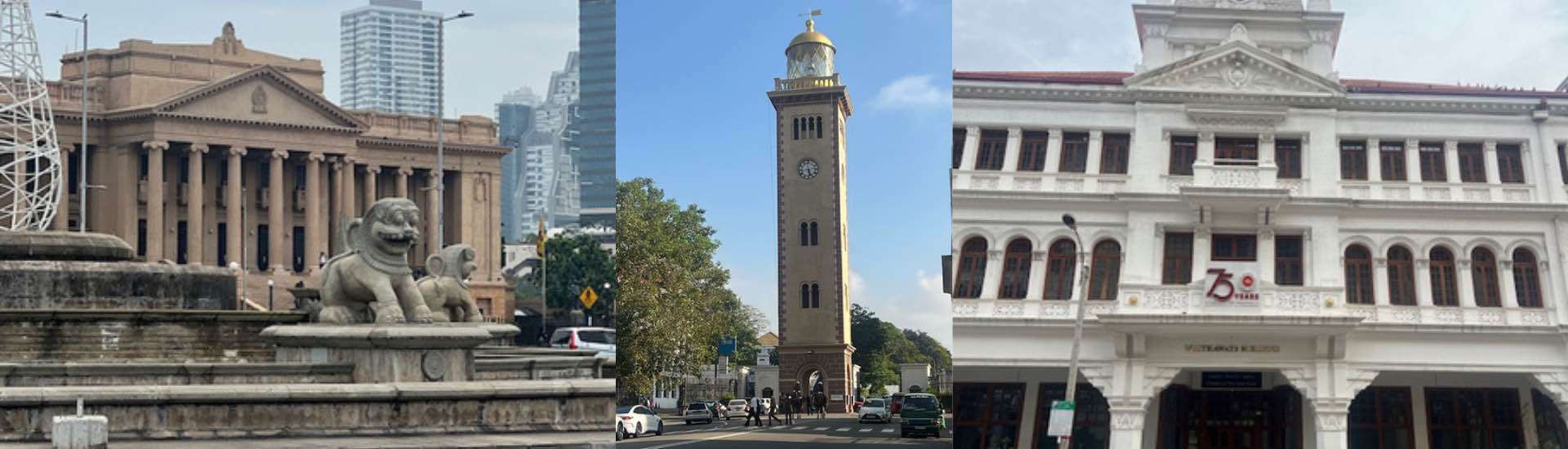
I always start with the King Sri Wickrama Rajasinghe prison cell in the Ceylinco House car park, where they say they kept the last King of Kandy before the British shipped him and his family to Vellore in India. The more likely story is that he stayed in a serviced house. On to the clock tower, once a lighthouse. It has four clocks and dates from 1857. It is still serviced by the UK company that installed it. On to the post office, dating from 1895, which has been renovated a few times in the last few decades. Go in and see its grandeur, a communication centre for the Empire. Now totally underutilised. Pass the President’s House of 1804, then take a right turn and see the amazing architecture and ongoing renovations. Sadly, many buildings were lost in the city due to LTTE bombings during the civil war.
A left turn, it is the Criminal Investigation Department. Don’t go down the tunnel. In the bad years, some people never came out. You can see many renovated Victorian period properties, some not completed. The Grand Oriental Hotel, 1875, is a port-facing, iconic property. Geoffrey Bawa did some renovations back in 1966. My older friends remind me of the Blue Leopard nightclub here.
Maintained buildings, clean roads and pride in the heart of the city of Colombo are coming back, but quite slowly.
Independence, mismanagement of the country, political unrest and civil war did not protect the Fort area.
There are many buildings undergoing serious work. Even when completed, who is going to occupy these monuments to bygone times? Imagine trying to air condition them.
I set up my office in Fort over twenty years ago, overlooking the port. It was a magical time, though there were bombings. I was near the Central Bank bombing in 1996, but still persuaded my PLC to invest in the country. None of this stopped me from walking around Fort, finding my favourite little church, St Peter’s, which was closed for decades. It is a history lesson and a tribute to those who supported the vision of the Fort; their efforts we see today. The Cargill’s store back in colonial times was just like Harrods. Today, there is only a small, dated shop. Find the statue on the right of the checkouts.
Lots of the colonial buildings have been renovated and act as the commercial and government hub for the island. Other buildings are in their second decade of renovation. Some will not make it.
Imagine arriving at Colombo Port Terminal in the heyday, walking two hundred yards and visiting the Grand Oriental Hotel, or going on the Green to the amazing Galle Face Hotel. The Fort railway station is a copy of Manchester station, but now has twice the passenger numbers. Thirty-eight million a year. Key hotels, including the Hilton and GOH, are government-owned and need to be sold off to the private sector. The Ritz-Carlton may never open. The Galadari, soon to be a Radisson, is privately owned.
The much-awaited, delayed flyover in front of the port will be a major traffic improvement, but an eyesore. The planning of Fort since its independence has been short-sighted and disconnected. Let us hope the renovations of historic buildings speed up, and Fort is more utilised. Imagine if you can, getting off your cruise ship and strolling through a clean Fort with its stunning properties, amazing shops, cafes, retail and culture.





0 Comments