Dec 12 2025.
views 821By Paul Topping
We head out on a twenty-metre yacht from Skopelos to Alonnisos, both islands of the Northern Sporades of Greece. The biggest island of the group is Santorini, with its legend of Atlantis. The full, blue early sky, even though it is September, tells us it is going to be a hot day.
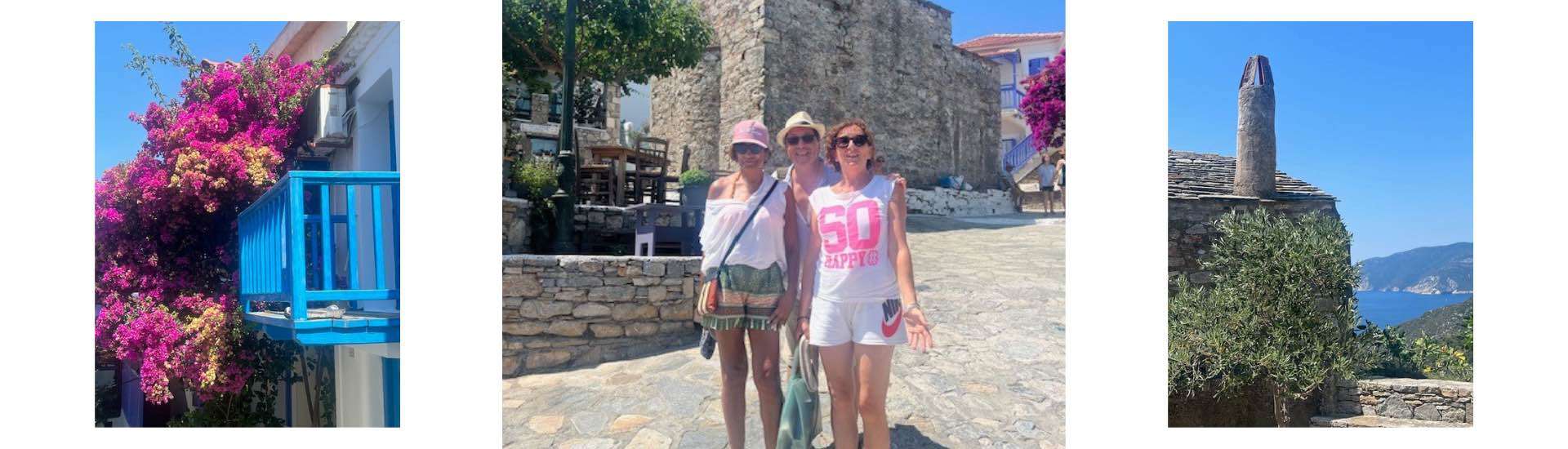
Skipper Juan and crewman Konstantinos welcome us on board for a trip to the island of Alonnisos. We arrive at a stone jetty in a town called Patitiri, with the biggest population in Alonnisos. Some of the villages on the island go back to medieval times. There are remaining walls of a Venetian fort.
We walk up through white houses with red roofs, looking at the many little shops. It is a winding upward set of steps, but we are rewarded with magnificent views of the coastline below. Our friend finds a small antique shop and buys a small wooden box with various drawers. On the walk-up, it is as though the sea is getting more blue, and there is not a cloud in the sky. The bobbing boats and the rugged coastline are spectacular. We take coffee from an open rooftop restaurant. Off again, we go up some stairs, where I spot a plaque. It is in memory of three locals who were shot by the Nazi Germans in the same spot, watched by all the villagers. In other towns on the island, a further eight islanders were also publicly shot for assisting in transporting allies off the island.
These moments always bring a tear to my eye. As I climb a few more steps, I get a call from my sister to tell me our dad has just died. He was in his mid-nineties, suffering for many years with dementia. His God had finally called him up. He had been a missionary and Methodist minister for most of his life. I had seen him a week earlier, surrounded by the extended family. I held back a tear but rejoiced that he was heading to his maker.
We walk up the hill to the top and look out on an even wider view of the blue ocean and sky. Beaches are generally pebbled on this island, just like Brighton in England, if you read my story a month back. There are also some tight, amazing little sandy bays on this twenty-five-kilometre island. I thought I was going to a small island, but later found it is sizable yet quiet. We sail back, stopping for a swim in the Aegean. In the years when pirates would raid these unprotected islands, people moved inland and upward. There used to be vines and wine on the island, but they were blighted by phylloxera.
The island has twelve beaches and bays, and the largest national marine park in Europe. Human activities are restricted in the area, and it has become a refuge for monk seals, dozens of fish species and dolphins. Some say it is the most unspoilt island in the southwestern peninsula of the Sporades. It did have major earthquakes in 1965, but today about 1,400 people live on the island, and it is good to hear that the biggest expat community are Austrians, then Germans. So there is a plan to revisit the island and explore further its marine activity and hidden beaches.






0 Comments