
Mar 18 2026.
views 195By Tina Edward Gunawardhana
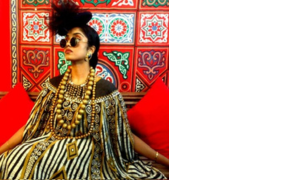
For decades, Senaka De Silva has been a vibrant and influential figure in Sri Lanka’s creative landscape—an artist, designer, model trainer and fashion guru who helped shape the country’s fashion industry from its earliest days. To many who grew up watching Colombo’s evolving creative scene, he was also an unforgettable presence. The writer remembers that as a young teenager, she was fascinated each time she saw him walking through her neighbourhood, his long tresses flowing in the sultry breeze, clad in handloom clothing. He looked every bit like a new-age mystic—artistic, unconventional and quietly charismatic. Today, after a lifetime immersed in textiles, craftsmanship and theatrical fashion presentation, De Silva is embarking on a new chapter, launching a designer training programme to guide the next generation of aspiring creatives. His aim is to pass on the knowledge, discipline and artistic grounding he believes every serious designer must possess.
De Silva’s fascination with art and fashion began early in childhood. Growing up in a home where elegance and creativity were part of everyday life, he absorbed visual inspiration from the world around him. “As a child, I was mesmerised by colourful textiles and ornate jewellery,” he recalls. “I always watched my mum dressing up—doing her immaculate hair, perfect saree draping and her simple make-up.”
His mother’s sewing machine also became an early gateway to creativity. “I watched and helped her sew on the old Singer sewing machine by turning the handle,” he says. “I used to draw and scribble everywhere—on paper and even walls.” His artistic curiosity soon extended into performance. “I always mimicked characters from plays and ballets,” he explains. “As I got older, I became the neighbourhood choreographer and play director, training the children for plays I produced and selling tickets to my aunts and uncles down the lane.”
Sri Lanka’s rich textile traditions made a deep impression on the young artist. He was inspired by the batik work of renowned Sri Lankan artists such as Soma Udabage and the legendary Ena De Silva. Determined to experiment, he began creating his own designs. “I experimented with candle wax and ink, saffron and anything that gave colour,” he says. His mother recognised his passion and enrolled him in the Melbourne Art Classes run by Mrs Cora Abraham on Dickmans Road in Colombo. By the age of thirteen, he was already producing batiks at home. “An aunt of mine used to buy them and send them to ‘Ceylon Fares’ in Germany,” he says.
After completing his O Levels, De Silva joined the prestigious Heywood Institute of Arts, where he studied under reputed teachers and explored a wide range of disciplines, including object drawing, life drawing, sculpture, wood carving, weaving and pottery. He eventually completed a diploma in pottery and ceramics. To support himself during this period, he worked part-time at the studio of designer Vipula Dharmawardena from 4 p.m. to 8 p.m., while living at the Divine Light Mission ashram. It was during these formative years that textiles and fashion gradually became his chosen artistic language. “Fashion and textiles became a fine art,” he says.
His work soon evolved into a distinctive aesthetic that combined Sri Lankan heritage with theatrical presentation. His collection “Shades of Sri Lanka” was created for shows presented by Air Lanka across the world. “They drew inspiration from my motherland and showcased the splendour of Sri Lanka,” he explains. For De Silva, fashion was never merely about garments—it was a visual spectacle. “Fashion became my fine art,” he says.
When De Silva began his career in the 1970s, Sri Lanka’s fashion industry was still in its infancy. Runway modelling as it exists today had not yet taken shape. “In the ’70s, there were no runway models,” he explains. “We took tall, beautiful girls and dressed them in my batik designs. They simply stood at exhibitions.” A turning point came when he was invited to organise a fashion show for the Muslim Ladies’ Study Circle together with Chrisanthi Fernandopulle. “We created ‘Cat Walk Rag’ and trained girls to model the outfits with theatrical themes and moods,” he recalls. Fashion shows in those days were largely entertainment, but they quickly gained momentum. “Later, the ‘Model of the Year’ contests followed, and the beauty pageants started. I trained many beauty queens, but most of them began as models—they had the training and the charisma.”
During the late 1970s and 1980s, De Silva was also closely involved in exporting Sri Lankan textiles to international markets. “We used to export batiks to Germany and France,” he explains. “Many artists took part in EGEDO in Düsseldorf. If you took the correct designs in the correct spring–summer colours, you were sure of big orders.” Scarves were particularly popular, along with bikinis, beach wraps and decorative wall hangings. Handloom textiles also found buyers in niche markets. Yet he believes Sri Lanka’s textile sector today faces serious challenges. “Our handloom and batik manufacturers need training in colour and design for international markets,” he says. “That guidance is lacking.”
It is precisely this gap that has inspired De Silva’s latest venture. Through his designer training programme, he hopes to teach young creatives the essential foundations of design—skills he believes are often neglected. “Most of the so-called fashion schools and universities have very poor syllabuses,” he says candidly. “Many students can’t even draw and don’t understand colour palettes or the colour spectrum. You have to study colour harmony and colour psychology.” Understanding the emotional power of colour is vital, he explains. “To create an impact, you must know what emotions colours create.”
Equally important, he believes, is the study of costume history and traditional design. De Silva himself has spent years researching Sri Lanka’s historic dress traditions, even creating costume history pageants for international archaeologists attending an ICOMOS convention many years ago. “If we do not have a history, what are we?” he asks. “Designers overseas constantly look at the past for inspiration. You have to dig into the past—it’s all about theatrics if you want to create an impact.”
His approach to teaching is personal and hands-on. “I find it easy to guide students individually,” he explains. “I sit with them at their drawing boards and train their eye to see proportions, shading, perspective, light and shade. They must learn life drawing and stylised fashion illustration.” Building a strong portfolio is essential, he says, particularly for those who hope to enter fashion universities abroad. While he acknowledges the growing role of artificial intelligence in the industry, he believes creativity must ultimately come from within. “The digital age with AI may be the future,” he says. “But what inspires you comes from your own memory, not from the computer.”
For De Silva, fashion remains a theatrical art form designed to captivate the senses. “If you want to make an impression with a new collection, you must create something the eye has not seen before,” he says. Designers, he believes, should study tradition but reinterpret it with imagination and confidence. “Traditions are not meant to stay stuck in history forever. What we create today will become history tomorrow.”
After a lifetime immersed in textiles, handicrafts, models and runways, Senaka De Silva now hopes to channel that experience into nurturing the designers of tomorrow. “I would love to impart my expertise and knowledge to the next generation,” he says, “and create dedicated, clever, knowledgeable young designers who will help the textile, craft and fashion industries thrive.”
Students interested in learning from the veteran designer can enrol in the Senaka De Silva Academy of Fashion Design and Fine Art, which offers a one-year diploma with master classes covering object and life drawing, fashion illustration, style history, colour harmony and psychology, textile design, accessory design, runway collection innovation and garment construction. The programme is limited to a maximum of ten students to ensure personalised guidance. The design studio is located at No. 7 Suranimala Place, Dutugemunu Street, Colombo 06, and the March intake is currently open for enrolment.







0 Comments