Oct 28 2026.
views 17
By Senina Weerasinghe
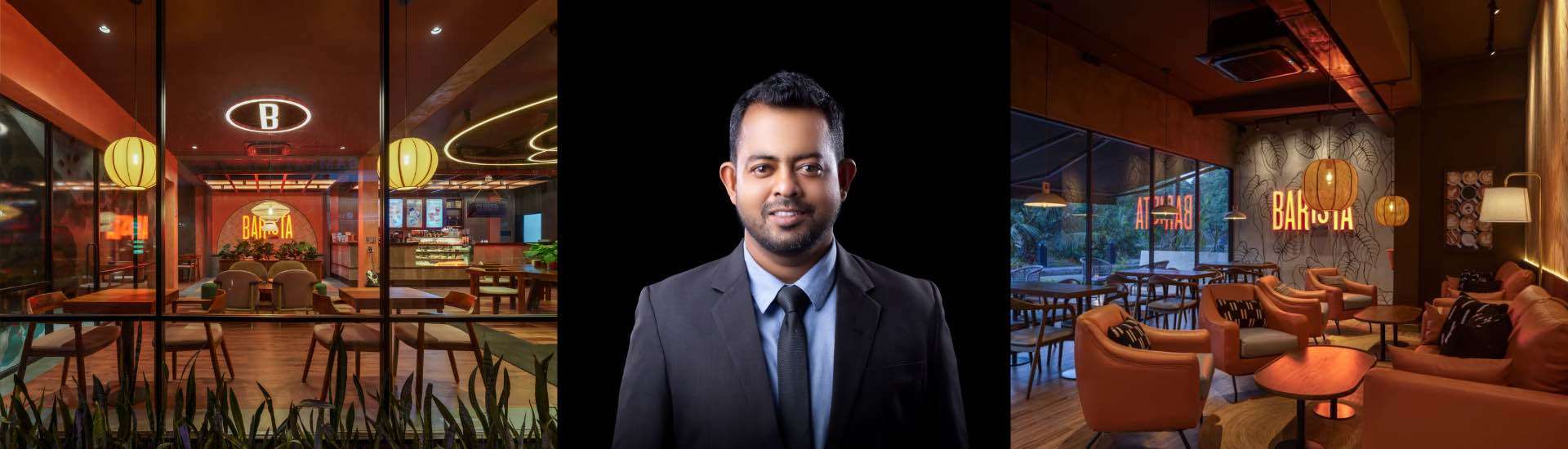
1. Barista has become a familiar name in Sri Lanka’s café culture. Looking back, what has the journey of building Barista in Sri Lanka meant to you personally?
For me, it is mainly about the impact that Barista has created. A business has many stakeholders — customers, employees, suppliers, investors, the environment, the community and the government. So when I think about the journey, I think about how much impact we can create for all of them.
People don't come into our cafés only for coffee. They study, work on assignments, have business discussions, exchange ideas, meet friends and spend time together. The café becomes a space where many different needs of the community come together.
We also have more than 1,000 employees, around 84 per cent of whom are below the age of 25. Many are young people who may not have followed a conventional educational pathway. We give them an opportunity to enter a disciplined, professional working environment, while also providing NVQ Level 3 and Level 4 qualifications.
We see the same principle with our suppliers. Some small and medium-sized businesses have grown alongside Barista. When selecting suppliers, we look not only at their finances, but also at their attitude towards quality, innovation, flexibility and willingness to learn.
For me, business is also a business of learning. We have to keep learning, adapting and moving quickly. Ultimately, the journey becomes meaningful when the value we create goes beyond the business itself and reaches our people, customers, suppliers and the wider community.
2. Sri Lanka has traditionally been known as a tea-drinking nation. How have you seen the country’s coffee culture and consumer habits evolve over the years?
When Barista started in Sri Lanka in 2002, it was essentially the beginning of the modern coffee scene here. For almost 17 years, there was very little expansion in the category. When I joined Barista in 2018, we had only seven outlets, and most of them were not profitable.
At that time, coffee was largely a premium proposition. Imported equipment, expensive locations and the investment required to create the right café environment naturally made it a high-end offering.
We reached an important point where we had to ask ourselves: why should coffee be available mainly to connoisseurs or a premium segment? Why couldn't we make it more affordable and create volume?
That is where the idea of democratising coffee came in. We wanted to bring the price down while maintaining the quality and experience associated with Barista. From around 2019 to 2026, our prices have not increased by more than roughly 20 to 25 per cent, despite significant increases in many other costs. We have always felt that we should not have a coffee that goes beyond Rs. 1,000 a cup, because we want people to feel that coffee is accessible.
Once we saw customers responding to that approach, we began moving beyond Colombo and expanding into areas such as Kandy, Galle, Kurunegala & Anuradhapura.
For me, the evolution of coffee culture has been about making coffee less exclusive and bringing it into the everyday lives of a much wider community.
3. Barista has now reached the milestone of its 100th outlet in Sri Lanka. What does reaching that milestone represent for you, and what were some of the challenges behind getting there?
When I look at the 100th outlet, I don't see it simply as a number. I think about everything we have gone through to get there.
The last six years have been extremely challenging — COVID-19, lockdowns, economic instability and periods when we didn't have the foreign currency needed to bring in coffee and other supplies. There were also times when electricity and fuel were a challenge.
But the 100th outlet belongs not only to me. It belongs to the whole team and to our customers who stayed with us through those difficult periods.
People came to Barista to work, conduct interviews and join team meetings. When companies were laying people off, some were trying to start their own businesses and needed somewhere to meet, work, connect and access Wi-Fi. We tried to adapt ourselves to facilitate those needs.
That is what means a lot to me. It is not only about how many outlets we opened or how much we sold. It is about how we navigated those challenges together.
And that brings me to trust. If our customers had not developed that trust and respect for Barista, reaching this milestone would not have been possible.
Our tagline is “Brewing Happiness.” In a country where people have had to carry so many challenges, I believe there should be at least one place where you can come, relax and perhaps be a little happier.
That is the kind of space we want Barista to be. Ultimately, the experience, trust and recommendation of our customers are some of the most powerful forms of promotion we have.
4. With a growing number of cafés and changing consumer expectations, how do you keep Barista relevant while maintaining the identity and standards that people have come to associate with the brand?
For us, staying relevant begins with being very close to the customer. We need to understand who our customers are, what they do in our cafés, how they choose a café and what influences their decisions.
In marketing, we talk about the seven Ps — product, place, promotion, price, people, physical evidence and processes. These are our tools. But the important thing is understanding how to use them and, more importantly, understanding who we are using them for.
We don't just want to understand the customer. We want to study the customer so well that we can anticipate what they might do next.
Our loyalty programmes, apps, kiosk systems and other mechanisms give us a lot of information. We can understand who is coming, when they come, who they come with, what they order, how long they stay and how their behaviour changes depending on whether they are alone or with someone else.
There are many untold stories behind the financial figures of a business. A loyalty programme, for example, can tell us how many times a customer has visited, when they come and what they order. We have even seen customers who have visited Barista on all 30 days of a particular month. Those are behaviours that we can understand, celebrate and learn from.
Why do I want to know the customer so well? It is not only so that I can serve you what you want. I want to know you well enough to anticipate your next move.
That is how we stay relevant. Customer preferences change, and we have to change with them. When I joined Barista, around 70 per cent of our beverage sales were hot beverages. Today, that has come down to around 55 per cent.
Maintaining our identity does not mean standing still. It means understanding what should remain constant while allowing the experience to evolve with the customer.
5. Barista has become more than a place to have coffee — particularly for young people, cafés have become spaces to study, work, meet friends and create memories. How important is this changing café culture to Barista’s vision?
For me, this is connected to something much bigger than coffee. We don't want Sri Lanka to lose out on international standards of experience.
As Sri Lankans, we have had to compromise on many things in our lives — education, healthcare, transportation, entertainment and facilities. I don't want our customers, particularly young people, to feel that they have to compromise on their café experience simply because they are in Sri Lanka.
We are the market leader in our category, and with that comes a responsibility. If you go to a café in Dubai, Singapore or the UK and experience something there, we want to be able to bring that experience to Sri Lanka as well. Our young people should not feel that they are missing out.
We are always hungry to bring the best to Sri Lanka — the best experiences, food, beverages and the newest trends.
But our purpose goes beyond the customer. I have always believed that if a business is only about making money, then it is a poor business. Businesses are there to make money, but there has to be a core purpose beyond simply maximising shareholder returns.
That is why we sometimes do things customers have never asked us to do. When we build beautiful outlets or develop an app to reduce waiting time, we are thinking about what would make the customer's life easier.
The same thinking applies to our wider responsibilities. We have taken initiatives such as contributing part of our Christmas menu revenue to SOS Children’s Villages and moving towards sugarcane-based, compostable packaging because we felt they were the right things to do.
I don't see a clear separation between the customer and the community. Our customers, employees and suppliers all come from the community, and our resources come from the environment around us.
So we have a responsibility to give more to the community than we take from it.
6. Behind a successful business are years of decisions, risks and setbacks that customers rarely see. Is there a particular challenge or difficult period in Barista’s journey that shaped the way you lead the business today?
We have actually been through very, very difficult times. I joined Barista in 2018, and from November that year onwards, the journey was anything but easy. In 2019, we had the Easter attacks. Then came COVID-19, which lasted for almost two years. After that, we went through the economic crisis and political instability.
We faced shortages of electricity, water and other basic facilities, and there was a period of complete chaos.
Sri Lanka was never quite the same after 2018, and going through all of that has shaped the way we think and operate today.
I always tell our team: if you are going through hell, keep going. If you can't run, walk. If you can't walk, crawl. But make sure you are still moving in the right direction.
That has become a practice for us as a business. There will always be success, obstacles and struggles. What matters is how you surpass those obstacles and what you take from them. You shouldn't simply push a problem aside and move on. You should learn from it, take what you need from that experience and keep moving.
I always say that if you focus on problems, the problems will continue to appear. If you focus on solutions, you will start finding solutions. If you really want something, you will find a way. If you don't really want it, you will find an excuse.
The years we have been through have also taught us that everything can be fragile — our systems, our people, our processes and the environment in which we operate. Because of that, we cannot afford to be rigid.
We have to be agile in our strategic choices, in our systems and in the way we work with our people. The ability to adapt quickly has become one of the most important lessons of everything we have experienced.
7. As someone who has built a major business in Sri Lanka, what do you believe young Sri Lankans need to understand about entrepreneurship, taking risks and building something of their own?
I think Sri Lanka has not really understood entrepreneurship with the amount of importance it deserves. But at the same time, we need to understand what entrepreneurship actually means.
Entrepreneurship is not simply saying, “I don't want to work in an organised environment,” or “I don't want to report to a boss.” It is not about wanting nobody to control you and deciding that you will have your own business.
If you look at Sri Lanka, we already have a large number of entrepreneurs. Farmers are entrepreneurs. Fishermen are entrepreneurs. Retailers are entrepreneurs. People selling things along the road are entrepreneurs. So the question is not whether we have enough entrepreneurs. The real question is: what kind of entrepreneurship do we need?
I believe what Sri Lanka needs is more educated, disciplined and hardworking entrepreneurs.
Education is not limited to having a degree or professional qualification. Education is an attitude — a willingness to keep learning, upgrade yourself and understand your industry better.
If you want to become an entrepreneur, you should be one of the most educated, hardworking and disciplined people in the room. When you are working in an organisation, there is a larger system around you. As an entrepreneur, the responsibility is much more personal, so you need to understand your business better than anyone.
I don't think you should be afraid of taking risks. When it comes to having a Plan B, the rational answer is yes — you should have provisions for a Plan B. But you should still give your first plan everything you have.
When you look at successful entrepreneurs, success often didn't come from their first attempt. It may have come from the second, third, fourth or fifth. What matters is that they didn't simply fall backwards. They fell forward.
To fall forward means that you make a mistake, learn from it and move ahead without making the same mistake again.
don't believe that failure is necessary for success. You don't have to fail in order to learn. If you do your homework, analyse properly, use the available data, have the right mindset and put in your complete effort, you can learn and succeed without having to fail first.
But failure is also a reality. You may fail once, twice or three times. That does not make you a failure. Failing in an event. Being a failure is a status - and you only become that when you decide to give up.
So even if something doesn't work, stand up, take the learning from it, do it differently and keep moving. Do your homework, educate yourself, work hard, be disciplined, put in your best effort and try to succeed from the first attempt.
You are not a failure until you declare yourself one — until you say, “I quit.”
8. Looking ahead, what is your vision for Barista Sri Lanka, and what do you hope the brand will continue to mean to the people who walk through its doors?
I want Barista to become a place associated with something bigger — the idea of freedom.
Today, we talk about Barista as a happy place. But I want to create a space where, when you walk in, you feel that you can be more productive, more focused and happier. It is almost a psychological approach to the environment we create.
The world outside is becoming busier, more competitive and more tiring, especially for young people coming out of university and for people coming from work. I want Barista to be a space where you can step away from that for a while and become the best version of yourself.
Something happened recently that made me realise how much this idea is already becoming part of what Barista is.
I was visiting one of our cafés and saw someone I knew. I asked him why he was there on a Wednesday morning. He told me, “I have some serious work to do at the office, so I came to Barista to do it.”
What struck me was that he actually worked in a modern office with all the facilities you would expect from a contemporary workplace. Yet he had chosen to come to Barista because he felt he could get his work done better here.
That tells me we have come a long way from being simply a café.
I see Barista becoming a space where people can come to work, study, think, focus and simply have a cup of coffee and be themselves, a space where they feel that their potential is awakened and where they can bring out their best.
But while we move towards that vision, we cannot compromise on what we have always believed in. Sri Lankans should not have to compromise on the quality of their coffee or the experience they receive simply because they are in Sri Lanka. If anything, I want us to be ahead of where the world is.
When I think about the future of Barista, I don't see it simply as a café getting bigger. I see it becoming a space that brings out the best in people.
If someone walks through our doors because they need to focus, work, study, think or simply feel better, and they leave feeling that they achieved something they couldn't quite achieve elsewhere — then I think we have done something meaningful.
That is the Barista we want to build: a place where people feel free, where their potential is awakened, and where they can become their best selves






0 Comments