Jun 17 2026.
views 19There’s something incredibly inspiring about seeing young Sri Lankans dream big, work hard, and make their mark on the world stage.
My guest today is proof that age is never a limitation when passion meets purpose. From the classrooms of Sri Lanka to the halls of Cambridge University, he has gone on to earn recognition as a UN Millennium Fellow while using technology and innovation to tackle one of our country’s most pressing conservation challenges.
What I love most about his story is that it isn’t just about personal success. It’s about using knowledge, technology, and a global platform to create meaningful change back home. His AI-powered initiative aimed at reducing elephant-train collisions is a reminder that some of the best solutions can come from young minds willing to think differently.
Today, we talk about ambition, innovation, the responsibility that comes with representing Sri Lanka on a global stage, and why the next generation may hold the answers to some of our biggest challenges.
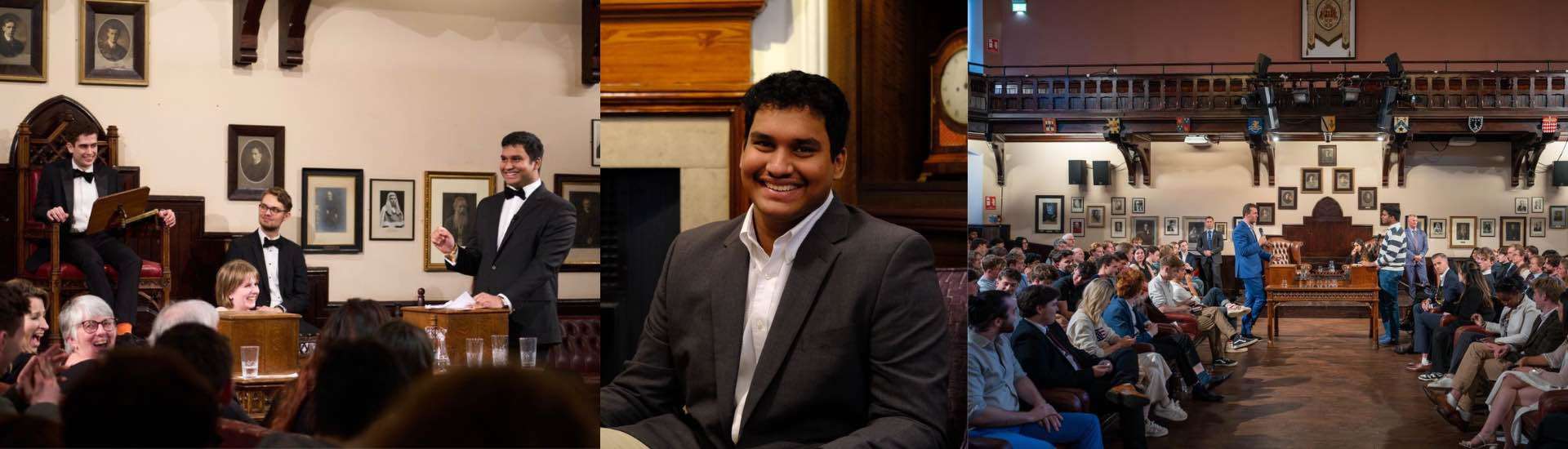
This is The Buzz with Danu, and I’m delighted to welcome Damsith Nimsara Wimalasena.
For someone meeting you for the first time, who is Damsith beyond the titles, awards, and achievements?
Beneath all of it, I'm someone who is endlessly curious, the kind of person who asks too many questions and gets quietly obsessed with understanding how things work. That instinct is really the engine behind everything else.
You grew up in Sri Lanka and are now studying at Cambridge. Looking back, what were some of the defining moments that shaped your journey?
The most formative one is also the most personal. I'm a triplet, so from the very beginning, I never knew what it was to feel alone, which is why my real culture shock at university was being apart from my two siblings for the first time in my life. Having spent every formative year as one of three, learning to stand as one of one took far longer than I'd anticipated, and it remains, quietly, the most difficult thing I've ever done.
When you first arrived at Cambridge, was there ever a moment when you felt overwhelmed or questioned whether you belonged there?
If I'm being brutally honest, not really, and I think that says less about my confidence than about how unusual I am to begin with. I'm the sort of person who watches election results for fun. As we speak, I'm following the Peruvian election (it’s a real nail-biter). For most of my life, that made me the slightly strange one in the room. So arriving at Cambridge didn't really feel intimidating; rather, it almost felt like relief. For the first time, all the strange people had been gathered into one place, and I was simply one of them.
You were selected as a UN Millennium Fellow from a pool of tens of thousands of applicants worldwide. What did that recognition mean to you personally?
It was validation that the problems I cared about, which often felt very local, very Sri Lankan, actually mattered on a global stage. We have a tendency to brush off solutions to hard problems as improbable, almost naïve, when in reality, technology is precisely the thing that turns the improbable into the achievable.
For many people, the UN Sustainable Development Goals are just words on paper. What do they mean to you in practical terms?
To me, the SDGs are a North Star, a shared sense of direction for progress, both at an individual level and, more importantly, at the level of society. I don't see them as seventeen abstract ambitions; I see them as a way of knowing whether you're actually moving things forward. If you can meaningfully address even a single SDG, however small the contribution, then by definition you've nudged society a step ahead of where it was.
Let’s talk about Coexist. Where did the idea of using AI technology to help prevent elephant-train collisions first come from?
Honestly? Waymo. I'd been watching self-driving cars navigate some of the most chaotic, unpredictable environments imaginable, spotting a pedestrian stepping off a kerb in the fog, reacting in a fraction of a second, and it struck me as absurd. Here we had machines mastering genuine chaos, yet in Sri Lanka, we were losing some of the most intelligent animals on earth to trains running on fixed schedules along fixed tracks: one of the most predictable systems you could possibly design.
Was there a specific incident or story involving elephants that stayed with you and pushed you to take action?
For me, it wasn't a single dramatic moment so much as a slow realisation. A couple of years ago, I did research for the Sri Lankan civil service on the human-elephant conflict, and as I worked through the official roadmap and the existing mitigation plan, one thought kept surfacing: most of these problems could be solved with technology. The methods we were relying on were strikingly rudimentary, like planting palmyrah trees as natural barriers, which have their place but were never going to scale to the size of the problem. There was nothing wrong with the intentions; the toolkit simply hadn't caught up with what was now possible.
Can you explain your technology in a way that someone watching at home, who may know nothing about AI, would understand?
Of course. Imagine giving the railway a pair of eyes that never blink, never tire, and can see clearly in the dark. The core of it is LiDAR, which is essentially radar made from pulses of light, and it builds a precise, real-time picture of what's near the track. On top of that sits our own AI, which we've built and which is proprietary to us; we've taught it what an elephant looks like, even at a distance or partly hidden. The moment it detects one on or near the line, it doesn't just say "something's there," it tells you exactly how far away the danger is, which means the driver gets a warning with enough distance to actually slow down and stop.
You are working on a solution that could potentially save one of Sri Lanka’s most iconic animals. Does that responsibility ever feel overwhelming?
Yes, it does, and I think it should. If a problem like this didn't weigh on you, you probably wouldn't understand it properly. That weight is precisely why we've taken our time. We've been in development far longer than a typical project, and that's deliberate: when the cost of getting it wrong is measured in lives, you don't rush to launch something half-ready.
Innovation often sounds glamorous, but the reality can be frustrating. What have been some of the biggest setbacks you’ve faced while building this project?
Three, mainly. First, false positives, the system has to stop flagging things that aren't elephants, because a warning people stop trusting is worse than none. Second, funding, if this were a for-profit venture, raising capital would have been straightforward, but a conservation project doesn't fit the venture mould, so the money is much harder to come by. Third, the field itself: I'm deeply committed to physical-infrastructure AI, but it's a different ballgame from software. You can't push an overnight update; you're up against the physical world, and it humbles you constantly.
As a young Sri Lankan innovator, do you find that people take your ideas seriously, or have you had to work harder to prove yourself?
I let the product speak for itself. As a rule of thumb, I aim for something twenty times better than what's out there and when the gap is that large, people can't easily dismiss it. Rather than convince anyone that a young Sri Lankan deserves to be taken seriously, I'd rather build something so clearly superior that the question answers itself.
You’ve been exposed to some of the brightest minds in the world through Cambridge and international programmes. What is one thing Sri Lanka is doing right that deserves more recognition?
Above all, we give ourselves far less credit than we deserve. Even in 2022, at the depth of one of the worst economic crises in our history, our literacy, life expectancy, and HDI stayed well ahead of most South Asian peers. Beyond that, two things: our free education system, which remains a genuine engine of upward social mobility, and a growing focus on policy continuity across administrations, because progress that survives a change of government is what actually compounds over time.
If you could sit down with policymakers, railway authorities, and conservation experts tomorrow, what is the one message you would want them to hear?
I'd tell them that much of the answer they're looking for already lies within technology. Too often, these problems are treated as intractable or reach instinctively for the tools of the past, when the solution is well within our grasp; it simply requires the willingness to adopt it.
What role do you believe technology and artificial intelligence will play in solving some of Sri Lanka’s biggest challenges over the next decade?
AI has enormous potential for good and for harm. It can transform productivity and create new opportunities, but if deployed carelessly, it can also widen inequality. That is why the real question is not whether AI matters, but how fast and how deliberately we move. My view is simple: we are not moving fast enough. We are barely scratching the surface of what is needed. For too long, we have been playing catch-up with other countries. The next decade is our chance to stop following and start setting the pace.
When you look ahead ten years, what would make you feel that your journey—from Sri Lanka to Cambridge, from student to innovator—was truly worthwhile?
If even a single life is changed for the better by something I've built.
Quick Fire
- One word that describes Sri Lanka? Resilient.
- One thing you miss most when you're abroad? Buddhist temples, and hearing pirith drift through the evening.
- A failure that taught you the most? An idea I was convinced would work and didn't (fall in love with the problem, not the solution).
- AI: exciting or scary? Very exciting.
- One Sri Lankan you admire? C.W.W. Kannangara.
- One dream you haven't yet achieved? To see Coexist deployed on trains across the country.
- Tea or coffee? Tea, by far. Five cups a day, easily.
- A book everyone should read? Thinking, Fast and Slow by Daniel Kahneman, and Poor Economics by Banerjee and Duflo.
- Elephant or lion? Elephant.
- What does success mean to you? Leaving a problem smaller than I found it, and a door more open than I found it.










0 Comments