Oct 20 2026.
views 27By Rihaab Mowlana
There is an incredible, unbothered arrogance in the assumption that a woman’s wardrobe is open for public jurisdiction. It is one of the few constants that survives across centuries, borders, and completely opposing political or religious spectrums. The rules change depending on who is holding power, but the impulse never shifts: a woman’s body is treated as a billboard for everybody else’s convictions.
This isn't a new fight. Men telling women how to dress, behave, and cover their bodies has been going on for millennia. In ancient Mesopotamia, upper-class women were forced to veil while poorer women were legally forbidden from doing so, using fabric to sort respectable women from the publicly available. In 1800s Britain, hemlines were measured to the arch of the foot, while table legs were draped to prevent suggestive thoughts. From forced foot-binding in China to 1990s Italian courts overturning rape convictions because a victim wore tight jeans, history is an endless timeline of society attempting to govern how much skin a woman is permitted to show.
What makes our current moment so absurd is how effortlessly these ancient impulses continue to manifest in modern life, operating in completely opposite directions at the exact same time.
On one side of the feed, a local clothing brand runs a commercial campaign featuring a male influencer lecturing women on how to be good daughters while explicitly telling them not to dress like sluts. It wasn't rage-bait designed for clicks, but a sincere commercial strategy. The brand was selling clothes by leveraging the oldest, most insidious lever in marketing: commercialised shame. Buy our product, but first, accept that your character, your family’s honour, and your upbringing are stitched into your hemline. When called out, there was no reckoning. Just the quiet removal of the promotional post. A retreat that assumes if you stay silent long enough, women will go back to consuming the exact paternalism used to degrade them.
Then look at Azerbaijan.
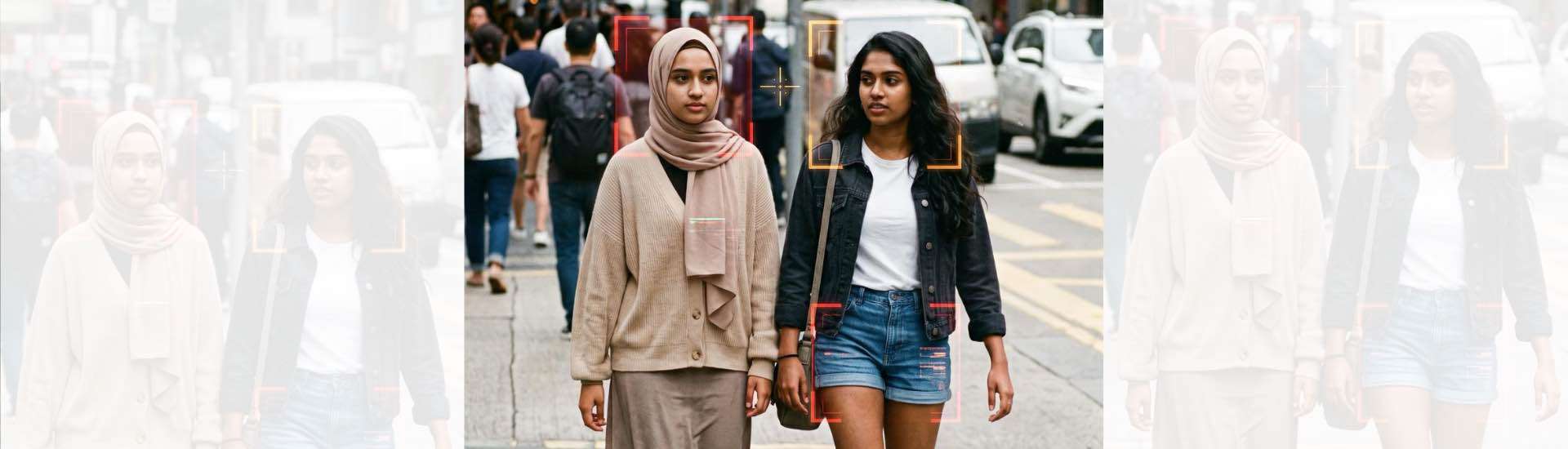
Under Resolution No. 309 and Decision No. 325, the state enforced dress-code regulations that effectively banned the hijab in state schools under the banner of protecting secularism. The mandate flips entirely. In a local ad, a woman is stripped of her respectability for covering too little. In Baku, Jalilabad, and Masally, teenage girls are physically turned away at school gates, and teachers are threatened with firing because their hair is covered. When students boycotted and citizens took to the streets, the state responded with mass arrests.
Put these two cases next to each other, and the pretence of values completely disintegrates.
If the local brand cared about modesty or honour, it wouldn't use a man to publicly degrade female shoppers to make a profit. If the Azerbaijani government cared about education or secular freedom, it wouldn't bar a teenage girl from a classroom because of a piece of cloth. Neither side gives a damn about the woman. One uses her as a vessel for commercial moralising; the other uses her as a political battleground for state compliance.
Underneath both cases lies the same lazy cultural narrative: shifting the responsibility for male behaviour onto female attire. Society constantly frames what a woman wears as a test, a provocation, or an invitation, suggesting that male self-control is entirely contingent on her willingness to adjust her outfit. It locks women into a perpetual, unwinnable trap. Dress too boldly, and you are labelled, scrutinised, and shamed. Cover up, and you are dismissed as backward, politically dangerous, or out of compliance.
What is particularly unhinged about the commercial side of this coin is the audacity of the male influencer. We have normalised a dynamic where men feel inherently qualified to step in as the moral arbiters of women's lives, acting as self-appointed guardians of a respectability they will never have to navigate themselves. A man can wear whatever he pleases without his attire being treated as a commentary on his father’s parenting or his moral fibre. Yet, he feels entirely comfortable looking into a camera and dictating the boundary between a good daughter and a slut, knowing that society has conditioned women to absorb that judgment as a valid critique rather than what it actually is: unearned, paternalistic noise.
Equally dishonest is the state's delusion of neutrality. When governments enforce secularism by stripping women of religious attire, they aren't liberating anyone. They are simply swapping one uniform of compliance for another. They frame the exclusion of headscarf-wearing girls as a triumph of modern enlightenment, completely blind to the irony that forcibly uncovering a woman is functionally identical to forcibly covering her. Both acts rely on the exact same premise: that a woman cannot be trusted to govern her own skin, and that an institution owns the exclusive right to decide what a neutral citizen looks like.
The result is a psychological tax that women are forced to pay every single day before they even leave the house. We do not just choose an outfit; we calculate the fallout. We measure hemlines against potential harassment, weigh religious expression against institutional access, and decide how much public judgment we are willing to stomach before lunch. It is an exhausting mental tax that men never have to factor into their daily existence, precisely because their bodies are viewed as the default human baseline, while ours are viewed as problems requiring constant management.
This is where public discourse continually fails: we treat this as a debate between modesty and secularism, or tradition and modernity. It is none of those things. It is about authority.
A woman who chooses to cover her body is exercising autonomy. A woman who chooses to show skin is doing the exact same thing. The violation occurs the moment an outside entity - whether an algorithm-driven brand or a state bureaucrat - attaches a penalty to her choice.
Right now, a woman can be labelled a slut online for revealing too much, and treated as an enemy of the state at a school gate for covering up. We have built a world where a woman’s body is permanently out of compliance with someone's standards. And until we call out the absolute absurdity of that setup, we aren't having a conversation about freedom; instead, we're just taking turns picking who gets to hold the leash.









0 Comments