Oct 27 2026.
views 24By Rihaab Mowlana
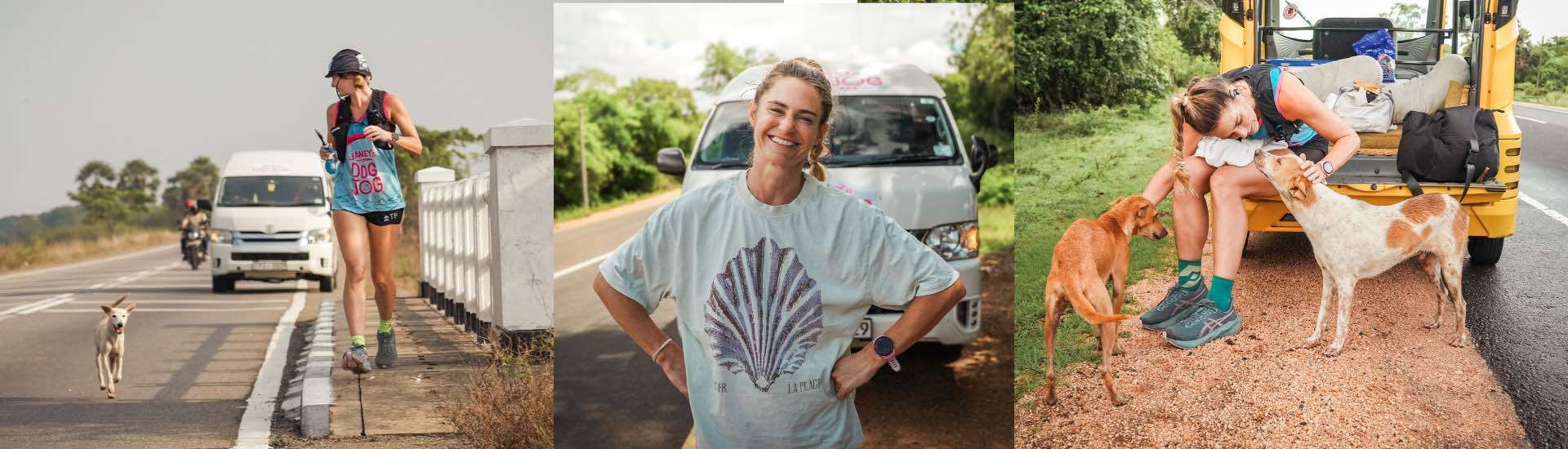
Dr Janey Lowes did not come to Sri Lanka to build a veterinary hospital. She came as a backpacker, saw sick and injured street dogs she lacked the equipment to treat, and decided to return for a year to help as many as she could. That was the plan. Today, she is the founder of WECare Worldwide, a charity that has treated more than 35,000 cats and dogs, and is running 620km across the country to raise funds for a £1.6 million hospital. Lowes made time for Life Plus in between stages of the run to talk about the work that began with a sense of helplessness, the animals she still thinks about, and why she believes Sri Lanka's veterinary profession needs a future that gives its own people reason to stay.
1. You came to Sri Lanka as a backpacker, not someone planning to build a veterinary hospital here. Do you remember the moment you realised you couldn't simply leave and forget what you'd seen?
It was hard for me to be here on holiday and see sick or injured dogs, but not have the equipment to help them. I planned to come back for a year to neuter, vaccinate, and treat as many dogs as I could, but it soon became clear that this was not a situation that would be resolved in one year. Coming back, I quickly saw the extent of illness and injury the dogs were dealing with and realised this wasn’t something I could ‘fix’ in a year.
2. You started by treating animals in your own home. Looking back, did you have any idea what you were getting yourself into, or were you simply taking things one animal at a time?
Not at all! My rented home was suddenly full of sick or injured animals, and I soon realised it wasn’t sustainable to be doing this from my house; I needed a proper hospital and more people to give the animals the care they needed, and help more animals. The need is so great that to this day, even though we often have 40 patients crammed into our hospital, there are still so many more in need waiting for our help. It’s endless. This new hospital will allow us to treat 3,000 more animals per year, which is why it’s so desperately needed.
3. What was the hardest part of building WECare Worldwide in those early days, particularly when you were working in a country that wasn't your own?
Oh gosh, so many things! Thankfully, I had great help from my friends Chaminda, Malika, and Dr Nuwan, but there were so many legalities and quirks in the system that are different to the UK, so I had a lot to learn. Funding was also a huge hurdle – I was fundraising as best I could, but I’m a vet, not a professional fundraiser, so I had no idea what I was doing! The charity ran out of money at one point, but luckily, we were then featured on TV in the UK, which brought in some more money. Fundraising will always be one of the hardest parts of running a charity, I think, when you rely completely on donations.
4. You've now cared for more than 35,000 cats and dogs. Is there one animal or one case that has stayed with you over the years?
There are so many animals that will never be forgotten; it is very tricky to pick out just one. Some are sad, some are the most incredible success stories, and one of those is Gooey, an emaciated street dog with severe mange and a huge tumour covering the whole of his face. We weren’t even sure if he had eyes when he arrived, but after a few months of treatment involving chemotherapy and reconstructive surgery, Gooey was well enough to go home and was adopted by the person who had reported him in the first place. Such a happy ending to a horrific case.
5. Working with injured street animals means dealing with suffering that you can't always prevent or fix. How do you cope with the cases you cannot save?
It’s hard. It’s really, really hard. I try not to show my emotions at work as the patients need me to be strong and clear-headed, but surfing is a huge outlet for me. I don’t get to surf as much as I’d like or need to, but the ocean is my therapy. It really helps.
6. What do you think people misunderstand most about Sri Lanka's street animal problem? And what needs to change beyond providing veterinary treatment?
Foreigners and tourists often find it hard to understand that a dog can live quite happily on the street so long as they have food, water, shelter, and access to veterinary care. There’s also a common misconception that Sri Lankans don’t love street dogs – obviously, not everybody does, but our experience is that the community wants to help the dogs. We actually couldn’t do what we do without the local community reporting sick and injured dogs to us. However, rabies is obviously endemic here, so that is understandably a huge fear – our education team works in the community teaching adults and kids about street dog welfare, and rabies awareness and prevention. This allows people to engage with animals responsibly, keeping themselves and their family safe, and the dogs happy and healthy. It’s a win-win!
7. The new hospital is a £1.6 million project. What will a purpose-built facility allow you to do that the current clinic simply cannot?
Our current rented hospital is falling apart and requires a lot of upkeep, which is super stressful and costly. Having our own facility will save money in the long run and allow us to focus more on other things, rather than stressing about the roof leaking on our expensive X-ray machine or mould affecting our staff’s health.
8. The hospital will also have a training centre. Why is training local people and building veterinary skills in Sri Lanka such an important part of your long-term vision?
There are SO many amazing vets in Sri Lanka, but many move overseas as prospects in the veterinary industry are often better there. It saddens me that people have to leave the country they love for a better life, so my dream is to help make the Sri Lankan veterinary industry one that local vets want to be a part of. While we can’t help dogs that are outside our area, upskilling local vets is our way of having an impact across the whole island.
9. Let's talk about the Dog Jog. You're planning to run 620km across Sri Lanka despite never having even completed the Great North Run. At what point did you decide that running the length of an entire country was a sensible fundraising idea?
Well, I’m not sure I ever thought it was sensible, haha. I was just wracking my brains to come up with something bonkers that would catch people’s attention and help us reach a wider audience of dog lovers who would get behind us and help us achieve this dream. I won’t lie - I’ve had many moments where I wonder why on earth I decided to do this, but I was desperate. I’m not a runner – in fact, I hate it – and some days of this run have been so hard, but my suffering is nothing compared to what many of the street dogs are going through. That’s what’s keeping me going in the tough moments (of which there are many…!).
10. What do you expect to be the toughest part of those 22 days, physically and mentally? And when you're exhausted, what will you tell yourself to keep going?
I'm lucky in that I'm incredibly determined – when I set my mind to something, I find a way of achieving it. I couldn't have built WECare without that determination. However, it's my body that will be the struggle. I sustained a knee injury during training that put me out of action for a while, and that was rough. There's a worry that my body will push back, but I hope I'll be pushing back harder. There's been some incredibly exhausting moments already, but then I see a dog at the side of the road, and I remember why I’m doing this. This isn't about me. It's about them. Their need is greater than mine, and I'll give everything to help them.
11. If you could go back to the vet who arrived in Sri Lanka on that backpacking trip, feeling helpless and unequipped to do anything, what would you tell her about the life she was about to build?
Oh gosh. I’d tell her that one day she’ll have a fully-equipped street dog hospital and a team of 80 amazingly passionate people working alongside her. I’d tell her that there will be LOTS of moments where she thinks she can’t continue, loads of sleepless nights worrying how she’ll pay the bills, and times where she wants to go home. But in the end, it all works out because she’s found her purpose and she’s living it, and that’s a privilege not afforded to everyone.









0 Comments