Jul 17 2026.
views 165By Kshalini Nonis
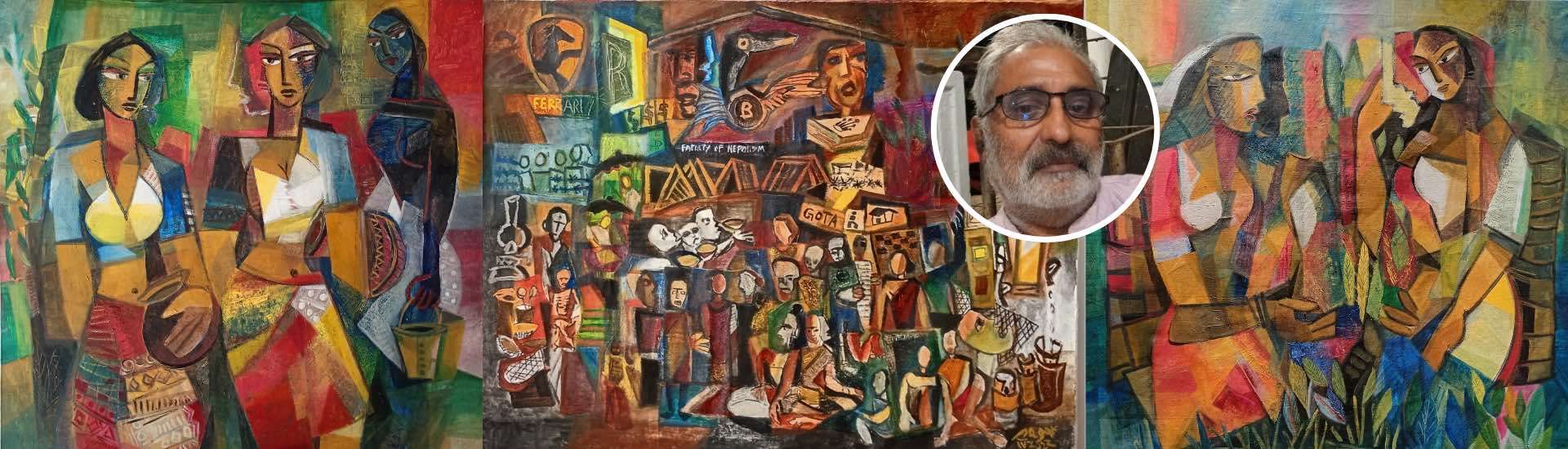
Raja Segar, one of Sri Lanka’s most well- known artists, needs no introduction. He is one of Sri Lanka’s finest contemporary artists, with some of his paintings bringing him international recognition and having been exhibited at famous art galleries in the UK, Australia and India. We had a chat with him about his impressive journey in art and some of the highlights of his career.
· You said, “I do not merely paint a subject; I look at how light fractures it, how lines divide it, and how colour can reconstruct its very essence.” What do you mean by this?
As I like to deviate from realistic paintings, I felt that I should create a style of my own. Therefore, I chose the refractive effect of light when it travels through different densities. This enabled me to have my own identity. When it comes to colours, as far as possible, I use the same brush without cleaning it. I also use the same canvas which I am working on as the colour palette.
· You have a long and impressive journey in Art. What are some of its highlights?
An engineer came to me with a card when my greeting cards were sold in the bookshops. He wanted a large painting of what was depicted in the card. It was a herd of cows with a shepherd titled; ‘Back home’ I told him ‘Sir, I am sorry, but I cannot do paintings but only make cards as I am not an artist.’ He replied, ‘Okay, then do a large card.’
And that is how I became an artist.
Another art collector who bought my painting wanted to return it after three months, as he felt that my painting did not have artistic value and that it would not appreciate in value with time. I displayed this painting in my gallery at the Ramada Renaissance Hotel. It was bought by a connoisseur from Hong Kong for a price that was three times more than what the previous buyer had quoted.
· What are some of your recent achievements in Sri Lanka and overseas?
In September 2022, I had an exhibition in Melbourne, which was organised by my friend Ajith Jayathilake. He was able to invite the Curator Wayne Crothers of the National Gallery of Victoria (NGV), Melbourne. Wayne was able to acquire two paintings from the connoisseurs who had already bought my paintings, as the NGV cannot deal directly with the artists. These two paintings, ‘The Village Tea Boutique’ and ‘The Housing Scheme’, are on permanent display at the NGV.
In 2025, I had three Solo exhibitions in Mumbai, Bangalore and Delhi by invitation. During my show in
Delhi, I met Mahishini Collone, the High Commissioner for Sri Lanka in India and our Prime Minister, Dr. Harini Amarasuriya.
· Can you tell us about a distinct aesthetic often termed “ Segarism” or “refractive abstraction” that you pioneered?
The word Segarism came into being due to the late Gwen Herath. She came to my exhibition at the Lionel Wendt gallery and wrote a review for the Sunday Observer newspaper. She connected my way of painting and the refractive effect, and originated the word Segarism.
· Can you tell us about ‘The Housing Scheme 1977’ and ‘The Buddha’ which are two famous paintings in your career?
‘The Housing Scheme’ painting was done out of fury because our house on Duplication Road was demolished for the construction of Liberty Plaza. I used my fingers in addition to the brushes. This painting is now at the NGV. ‘The Buddha’ painting was done out of my love for Buddhism. This became so unique that even I am unable to copy it. I priced this painting in such a way that nobody will be able to buy it.
· Your work has reached audiences far beyond gallery walls, including international publications – tell us about being featured in the Reader’s Digest.
I really don’t know how this reached international periodicals and publications. An Australian who bought my ‘Tea pluckers’ sent it to the editorial of Reader’s Digest in Hong Kong. They wrote to me asking for my permission to feature on their back cover. I gave my approval, and they sent me a cheque.
· Please tell us how you are currently preparing to share your vision with a new generation in a
monumental, trilingual art book (in English, Sinhalese and Tamil) designed for the University of Fine Arts.
I am still working on this book. I am unable to get a Tamil typist. Although I tried to translate through AI, I was not successful. However, this book will be completed soon.
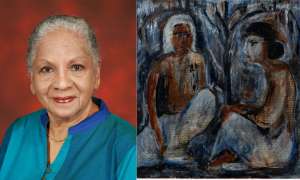
· Tell us about the house you live in that was built by the late Minnette De Silva and how it was conceived from your imagination when you were 12 years old?
I met Minnette in Kandy during my exhibition at the Alliance Française de Kandy. She wanted to buy my
abstract paintings on buildings, but they had already been sold.
I did a painting of buildings on canvas and gifted it to her. She visited me in Ja- ela and was impressed by the contour (similar to lands in Kandy). After seeing the model and architecture drawing she did for my house, I could not resist the temptation of building the house.
This house became well-known and was even listed in the Princeton University of Architecture in New Jersey, USA.
· Who are some of the artists that inspire you?
When I was in school, I was fascinated by Senaka Senanayake’s paintings. I go to his exhibitions in Sri
Lanka. I was pleasantly surprised that he helped me a lot in my career later on. I am very grateful to him. Another artist who influenced me was Vincente Manansala of the Philippines.
· Finally, how do you hope to continue your work as an artist in the future?
I look forward to seeing my paintings being a part of international auctions like Sotheby’s and Christie’s (the way Indian art is doing).





0 Comments