May 12 2026.
views 10By Rihaab Mowlana
The Monday following the second Sunday of May is characterized by a specific kind of quiet. The digital sirens have ceased, the floral arrangements are beginning their inevitable descent into wilted brown edges, and the collective Social Hangover sets in. We have emerged from forty-eight hours of high-stakes, high-contrast digital theater.
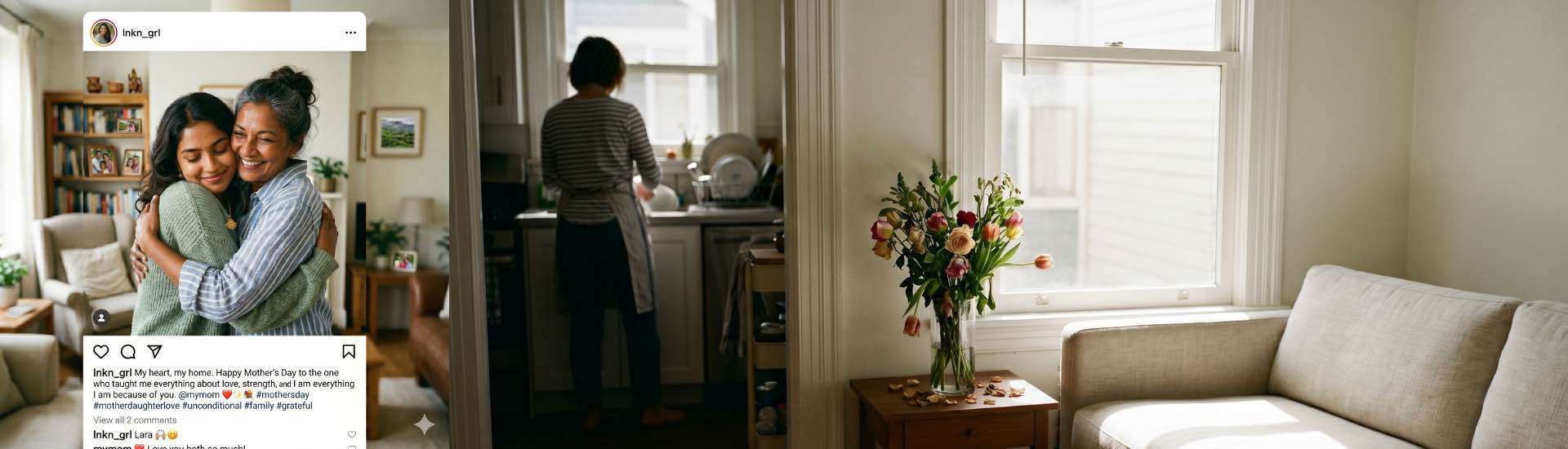
If you spent the weekend scrolling, you witnessed a curated pageant of maternal perfection. You saw the sepia-toned childhood throwbacks, the meticulously staged brunches, and the captions - paragraphs of prose that read less like a thank you and more like an audition for a creative writing fellowship. But as the grid returns to its regularly scheduled programming of coffee shots and work-from-home aesthetics, a question remains: Who was that performance actually for?
The Architecture of the Digital Tribute
In the pre-digital era, Mother’s Day was a private, domestic affair. It was marked by a phone call, a card that might stay on a mantelpiece for a week, or perhaps a slightly charred piece of toast served in bed. It was intimate, messy, and - crucially - unobserved.
Today, the Architecture of Appreciation has been externalized. We have moved from the private mantelpiece to the public square. When we post a tribute to a parent, we are engaging in a form of Identity Branding. Psychologically, the post serves two masters. The first is the recipient (who may or may not even be on the platform). The second is the Audience. By publicly celebrating a perfect maternal bond, we are signaling our own virtues: our capacity for gratitude, our stable upbringing, and our participation in the societal norm of the happy family.
This is the Content-ification of sentiment. We are no longer just living our lives; we are managing them as a series of editorial assets. The moment we pick up the phone to capture the perfect candid moment, the chemistry of the interaction changes. We shift from Participant to Producer.
The Invisible Labor of the Post
There is a profound irony in the Mother’s Day Post. Motherhood is, at its core, a legacy of invisible labor - the cooking, the cleaning, the emotional regulation, and the management of a household that goes largely unrecorded. Yet, we celebrate this invisible labor by creating more labor.
The process of performing appreciation is, in itself, an exhausting administrative task. It requires the selection of the right asset (the photo where everyone looks happy, but the lighting is also editorial-grade), the drafting of a Strap Line that feels authentic but not clinical, and the subsequent monitoring of engagement.
For the modern professional, this is simply another project to manage. We have turned a day intended for rest into a day of production. We are working the holiday, ensuring that our personal brand’s Family pillar is sufficiently updated. The psychological toll of this is a phenomenon known as Spectatoritis - the condition of being so focused on how an event looks to others that you cease to experience the event itself.
The Psychology of the Public Witness
Why does a private "I love you" feel insufficient in 2026? The answer lies in our evolving need for a Public Witness. In a secular, fragmented society, social media has become the ledger of our existence. If a milestone isn't documented and witnessed by a digital tribe, there is a nagging, subconscious fear that it didn't truly happen.
This creates a Validation Feedback Loop. When the likes and comments roll in on a Mother’s Day post, the brain receives a hit of dopamine. However, that dopamine isn't tied to the mother-child relationship; it’s tied to the performance of it. We are being rewarded for our ability to simulate intimacy, not for the intimacy itself.
This creates a dangerous Comparison Trap. For those who have complicated, fractured, or grieving relationships with their mothers, the second Sunday of May is a minefield of Standardized Happiness. The pressure to perform can lead to a sense of Performative Guilt, the feeling that if your post isn't as poetic as your neighbor's, your relationship must be fundamentally lacking.
The Rise of the Colder Aesthetic and Radical Privacy
As digital culture matures, we are seeing the first cracks in this performative wall. There is a growing Post-Instagram fatigue, a move toward what we might call Radical Privacy.
This is the soft pivot away from the grid. We are seeing a new editorial aesthetic emerge: the Anti-Post. It is the deliberate choice not to share. It is the realization that the most valuable moments are the ones that are too messy, too dark, or too private to be flattened into a 3:4 vertical ratio.
The Pivot: From Production to Presence
As we move into the rest of the year, the challenge is to de-couple our sense of worth from our digital output. How do we shift from being Producers of our Lives back to being Inhabitants of our Lives?
It starts with the quiet move. It’s the decision to send a long, rambling voice note instead of a public caption. It’s the decision to print a photo and put it in a physical frame where only the people in that house will ever see it.
The social hangover will fade, and the flowers will eventually be thrown away. But the relationships that survive the Performance of Appreciation are the ones that don't need a witness to thrive. In a world that demands we broadcast everything, the most radical thing you can do is keep something for yourself.








0 Comments