Sep 22 2026.
views 8There was a time when borrowing sugar, sharing meals and checking in on the family next door were part of everyday life. Today, many Sri Lankans couldn't tell you the name of the person living beside them. Has modern life quietly changed one of our oldest relationships?
By Rihaab Mowlana
Do you know your neighbour's name?
Not the one who parks the white SUV next door. Not the family whose dog barks every evening. Their actual name. It's a surprisingly difficult question for many Sri Lankans to answer.
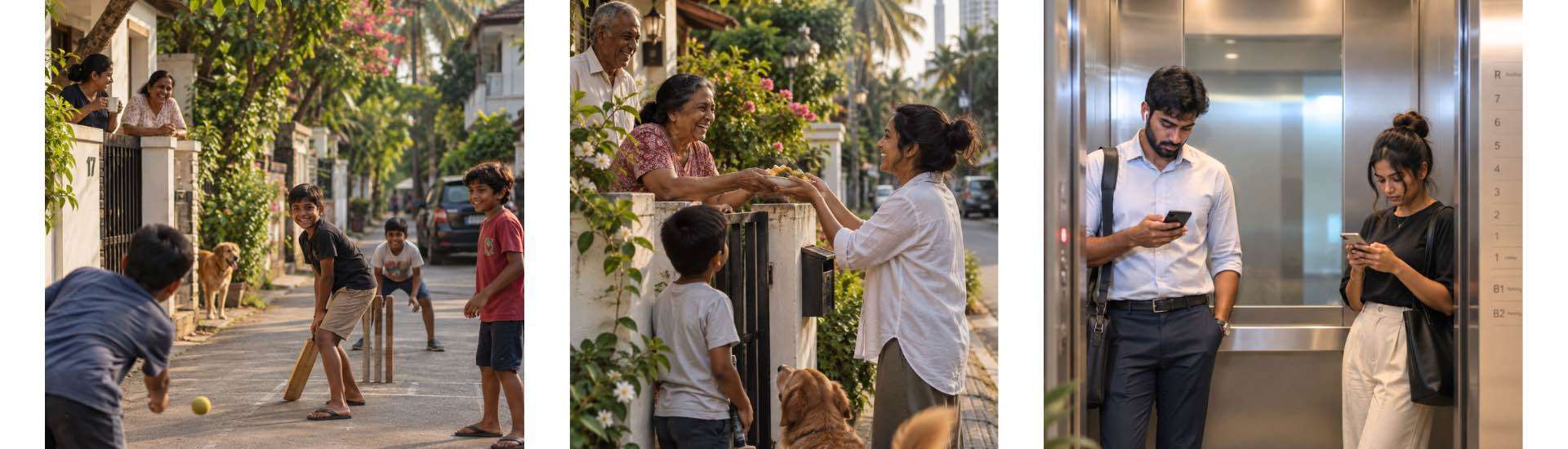
A generation ago, it would have been almost unthinkable. Neighbours weren't simply people who happened to live nearby. They borrowed sugar when they ran out, exchanged plates of food during Avurudu, Ramadan, Christmas and Deepavali, watered each other's plants during holidays, collected parcels, watched over children playing in the street and often became the first people you called when something went wrong.
Today, the relationship appears different. We know our neighbours' cars more readily than their names. We exchange polite smiles in apartment corridors. We wave through car windows as automatic gates slide shut. In many neighbourhoods, it is entirely possible to live beside someone for years without ever stepping inside their home.
So what changed?
For 68-year-old Chandrika Jayasinghe, who has lived in the same Colombo neighbourhood since the early 1980s, the transformation has happened gradually rather than suddenly.
"When we first moved here, our front gate was rarely closed," she recalls. "Children ran in and out of each other's houses. If someone made kokis for Avurudu or wattalappam for Ramadan, everyone nearby received a plate. If a family had a wedding, the whole street was involved." She remembers borrowing onions, sugar and curry leaves without thinking twice. "Nobody kept count," she laughs. "You returned it another day. It wasn't about the ingredients. It was about knowing someone was there."
Today, many of the original residents have moved away, while newer families often keep to themselves. "It's not that people are rude," she says. "Everyone seems busy. Life has become much faster."
That sentiment is echoed by 30-year-old software engineer Kevin Fernando, who has lived in a Colombo apartment complex for almost three years.
"I know the faces on my floor," he says. "We hold the lift for each other and say hello, but that's about it. I couldn't tell you most of their names." He doesn't see it as unfriendly. "It's just different. Most of us leave early, come home late and spend the rest of the evening catching up on work or relaxing. Meeting friends usually happens somewhere outside the home."
That shift may say as much about modern life as it does about neighbours themselves. Longer working hours, heavier traffic and dual-income households have dramatically changed the rhythm of Sri Lankan life. Evenings that were once spent on verandas or in front gardens are now often spent commuting, answering emails or recovering from the day. Hosting guests, or even stopping for a lengthy chat over the fence, has become harder to fit into increasingly packed schedules.
Housing has changed too. Many younger Sri Lankans now live in apartments or smaller urban homes where entertaining large groups is less practical. Front gardens have become parking spaces. Verandas have disappeared behind walls. New housing developments often prioritise privacy and security over communal spaces where neighbours naturally interact.
Sociologists have long argued that communities are built through repeated everyday encounters rather than major events. A brief conversation while watering plants, watching children cycle down the street or collecting the morning newspaper may seem insignificant on its own, but over time these small interactions create familiarity and trust. Without them, neighbours remain strangers.
Technology has also altered how we maintain relationships. Instead of chatting over the fence, we catch up through WhatsApp. Rather than dropping in for tea, we arrange dinner weeks in advance. Our closest friends may live on the other side of the country, while the people sharing our boundary wall remain largely unknown. Ironically, we are more connected than ever, yet often less connected to the people living closest to us.
Privacy has become another defining feature of modern life. Previous generations often considered an open-door policy a sign of warmth and hospitality. Today, many people value personal space more highly. An unexpected visitor may be viewed as an interruption rather than a pleasant surprise. Closed gates, CCTV cameras and digital doorbells reflect changing ideas about security, but they also create subtle barriers between households.
Yet stories from recent years suggest the neighbourly spirit has not disappeared altogether. During the economic crisis, people shared fuel, exchanged groceries and checked on elderly residents. During periods of flooding, neighbours helped move furniture to higher ground and opened their homes to families affected by rising water. Across the country, ordinary people stepped in long before formal assistance arrived.
Maybe those moments reveal something important. The willingness to help still exists. What has changed are the opportunities to build those relationships before a crisis arrives.
Sociologists believe this reflects a broader shift in how communities are formed. Previous generations were rooted in neighbourhoods because most aspects of life revolved around where they lived. Today, people build communities through work, education, hobbies and online spaces. Geography is no longer the defining factor it once was. That doesn't necessarily mean community has disappeared. It has simply been reorganised. Still, many wonder whether something valuable has been left behind.
Neighbours once noticed when your lights stayed off for too long. They knew when someone was unwell. They collected your mail while you travelled, fed your pets during emergencies and celebrated life's milestones alongside your family. These weren't grand gestures. They were small acts of everyday care that quietly made neighbourhoods feel safer and more connected.
For younger Sri Lankans, however, expectations have evolved. "I don't think people are less caring," says Kevin. "If I knocked on my neighbour's door because I genuinely needed help, I believe they'd help me. We just don't have the kind of relationship where we'd casually visit each other." That distinction feels significant.
Maybe the issue isn't that neighbourliness has vanished. Maybe it has become dormant, emerging only when circumstances demand it instead of being woven into daily life.
As cities become denser and lives become busier, the value of knowing the people next door may become even more important. Research from around the world has consistently linked strong neighbourhood connections with greater trust, increased feelings of safety and improved wellbeing. Sometimes, simply recognising the person across the fence is enough to foster a sense of belonging.
The question, then, is not whether we can return to the neighbourhoods of the 1980s. Modern Sri Lanka is different, and so are the lives people lead.
But perhaps there is still room for something as simple as introducing yourself to the person next door, sharing a plate of festive food, or stopping for a conversation that lasts a little longer than the time it takes for the lift doors to close.
The walls between our homes may be getting higher. Whether the walls between us need to is a choice we still have the power to make.











0 Comments