Feb 10 2026.
views 300By Rihaab Mowlana
Someone will read this headline and already feel informed enough to argue with it, which is precisely the point.
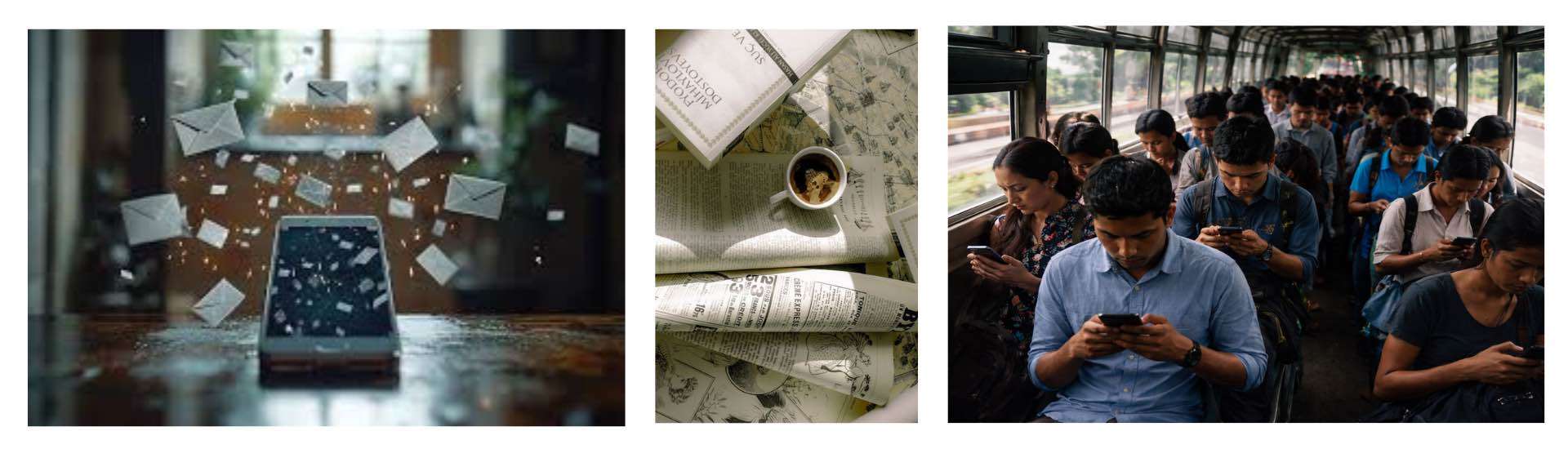
We love saying Sri Lankans do not read anymore, that attention spans are shrinking, that nobody has patience for long articles, books, or context, but that diagnosis is lazy because it assumes absence when the real problem is overload. We are not starved of information. We are drowning in it. Notifications, reels, Twitter threads, WhatsApp forwards, Instagram carousels explaining geopolitics in six slides, and AI summaries that promise knowledge without the inconvenience of thinking have turned information into something we consume endlessly but rarely process.
We scroll, we nod, we react, we share, and then we move on feeling informed without ever being transformed.
Reading used to be an act of commitment. You sat with a newspaper, a book, or even a badly photocopied article, and you stayed long enough for ideas to irritate you, challenge you, or force you to reconsider something you thought you already knew. Today, reading has been redesigned into grazing. Bite-sized, agreeable, fast, emotionally validating. If it takes more than a minute, it is too long. If it makes you uncomfortable, it is problematic. If it contradicts your worldview, it is biased. We are not reading less. We are reading shallower.
The rise of reels-as-education is the most visible symptom. Complex topics like economics, feminism, mental health, geopolitics, and law are now introduced, explained, and concluded in under sixty seconds, often by people with confidence rather than competence. And confidence travels faster than nuance. It looks convincing. It sounds authoritative. It gives you the illusion of mastery without the burden of uncertainty.
This is how misinformation thrives without always being obviously false. Not everything circulating online is wrong. Much of it is incomplete, contextless, or strategically simplified until the sharp edges disappear. A half-truth wrapped in aesthetic fonts and calming background music is still a distortion, but it feels gentle enough to trust. And we trust it quickly because we want to feel informed without feeling overwhelmed.
There is also something deeply seductive about summaries. Headlines tell us what to think. Threads tell us how to feel. Captions tell us who to blame. We skim the top layer and mistake recognition for understanding. When someone challenges us, we are startled not because we are wrong, but because we never realised how thin our knowledge actually was. This is where certainty becomes dangerous.
We now live in a culture where everyone has an opinion, but fewer people have arguments. Where disagreement is treated as a personal attack. Where being corrected feels humiliating instead of useful. Because to admit “I don’t know enough about this” now feels like failure in a world that rewards instant takes.
Social media has also trained us to read for affirmation rather than interrogation. We save posts that echo what we already believe. We follow accounts that speak our language, share our anger, and confirm our suspicions. Algorithms quietly curate our intellectual diet until it becomes an echo chamber that feels like truth. And when reading becomes a mirror instead of a window, growth stops.
This shift has real consequences beyond culture wars and comment sections. It affects how we vote, how we debate policy, how we judge public figures, how we engage with activism, and how we treat nuance as weakness rather than strength. When complex issues are flattened into villains and heroes, solutions become performative instead of practical.
We have also turned education into content. Everyone is an explainer now. Everyone is a coach, a therapist, a political analyst, a financial advisor, armed with Canva slides and a ring light. Expertise is treated with suspicion unless it is entertaining. Depth is boring unless it is viral. And yet, we complain constantly about being misled.
There is an irony here that is hard to ignore. We are consuming more words than any generation before us, but fewer of them stay with us. We are exposed to more perspectives, but listen to fewer. We have access to libraries' worth of information in our pockets, but rarely sit still long enough to let any of it change us.
Reading, real reading, demands humility. It requires accepting that you might be wrong, that you might need to slow down, that understanding takes time, and that not every answer fits into a caption.
The problem is not that long-form writing is dying. It is that patience is being treated like an outdated skill.
And patience is political. It shapes how deeply we engage with injustice, how thoughtfully we respond to crisis, and how responsibly we participate in public life. When everything is reduced to quick outrage or quick inspiration, sustained action becomes difficult.
This is not a call to abandon social media or romanticise the past. The internet has democratised access to information in powerful ways. Voices that were once silenced can now speak. Marginalised stories can now travel. Awareness can spread faster than ever.
But awareness without depth is fragile. It cracks under pressure. It collapses the moment something complicated refuses to fit the narrative we memorised from a reel.
What we need is not more content. We need better reading habits. We need to relearn how to sit with discomfort, how to read past the headline, how to question sources, how to pause before sharing, and how to say “I need to learn more” without shame.
Intelligence is not about how much information you consume. It is about how well you understand what you consume and what you choose to do with it. We are not stupid. We are overstimulated, under-reflective, and constantly rushed to have an opinion before we have earned one. And until we slow down long enough to digest what we read, we will keep confusing familiarity with knowledge, noise with insight, and confidence with truth. Until next time, read slower.






0 Comments