Mar 17 2026.
views 205By Rihaab Mowlana
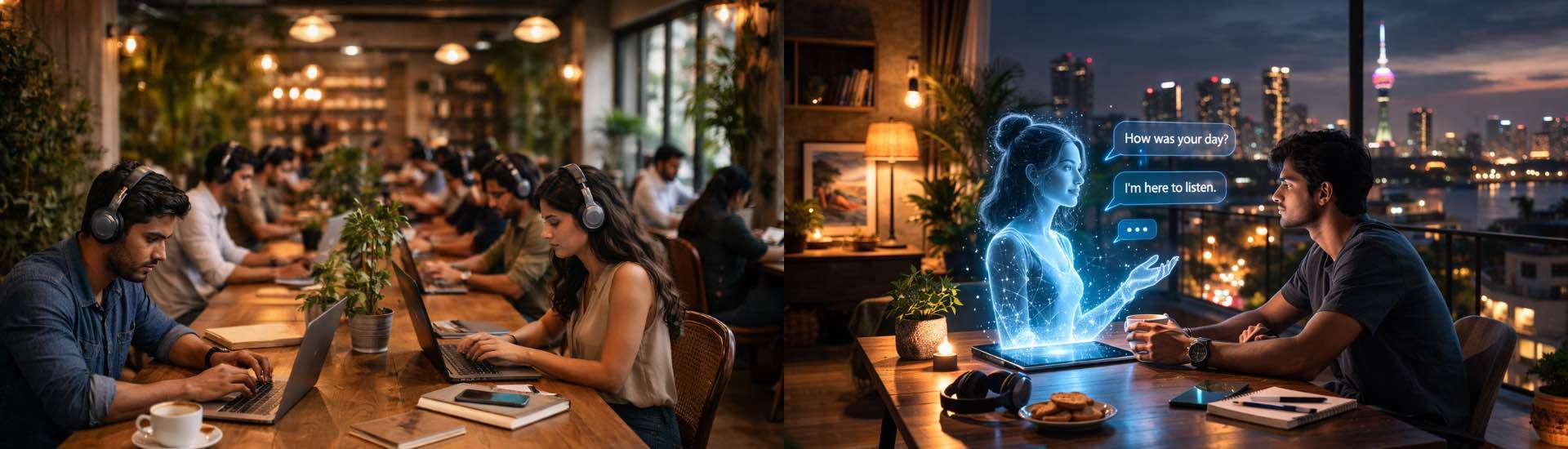
Not long ago, loneliness was considered a private ache, something people endured quietly and rarely discussed in polite company. Today, it is a market. Around the world, companies are building services designed to soften the edges of solitude: AI companions that text you throughout the day, co-working cafés where strangers work quietly, side by side, and travel companies now design group trips specifically for people who arrive alone but want the experience of temporary community. What was once an emotional condition has slowly become something else entirely. Loneliness, it seems, is now an industry.
Researchers and policymakers increasingly describe loneliness as one of the defining social conditions of modern life. In the United Kingdom, the government even appointed a Minister for Loneliness after studies revealed that millions of people regularly experienced persistent isolation. Similar concerns have surfaced across the United States, Europe, and parts of Asia, where public health experts now warn that chronic loneliness can have consequences comparable to smoking or obesity. Yet while governments debate policy responses and researchers publish reports, the private sector has moved quickly in another direction. Instead of treating loneliness as a problem to solve, businesses have begun treating it as a need to serve.
When Solitude Became Normal
The shift did not happen overnight. Over the past two decades, modern life has gradually reorganised itself around convenience and individual autonomy. Food arrives with a tap. Entertainment streams endlessly on personal screens. Work increasingly happens from home rather than in shared offices.
These changes have brought efficiency and flexibility, but they have also quietly reshaped how people interact with one another. Many of the small social rituals that once structured daily life have faded into the background. The quick chat with a colleague before a meeting begins. The neighbourly conversation at the corner shop. The spontaneous gathering after work.
In their place is a life that can be lived with remarkable independence. Groceries, entertainment, communication, and even friendships can be maintained through a device in one’s hand.
For many people, this independence feels empowering. Living alone, once viewed with quiet concern, is now often framed as a marker of modern adulthood. Solo travel is celebrated. Solo dining is increasingly common. The idea of enjoying one’s own company has been rebranded as a kind of lifestyle.
But independence, like most freedoms, has its trade-offs. A life designed for convenience can also become a life lived slightly apart from others.
The Market for Human Connection
Where social structures change, markets rarely stay silent for long. In Japan, where urban isolation has long been a topic of national conversation, services allowing customers to rent a friend for an afternoon have existed for years. Clients hire companions to accompany them to dinner, attend events together, or simply spend time in conversation. The arrangements are professional rather than romantic, but they offer something simple and valuable: presence.
Elsewhere, entrepreneurs have turned their attention to technology. Artificial intelligence companions are gaining popularity in several parts of the world, offering users digital conversation partners that remember personal details, ask questions about their day, and respond with surprising emotional fluency. For some, these virtual relationships provide comfort during long stretches of solitude.
Even industries not traditionally associated with companionship are adapting to the new emotional landscape. Co-working spaces, for instance, are often framed as a solution for remote workers seeking office infrastructure. Yet many members admit that the appeal lies elsewhere. Being surrounded by others, even in quiet concentration, recreates a subtle sense of community that home offices cannot easily replicate.
Travel companies have noticed the same shift. An entire segment of tourism now caters to solo travellers who want independence without isolation. These curated group trips allow people to arrive alone but experience destinations alongside strangers who share the same journey. In each case, the connection is not quite accidental. It is designed.
Designing Spaces for Strangers
The rise of the loneliness economy reflects a curious paradox of modern life. The very technologies that made independence possible have also weakened some of the informal structures that once sustained the community.
Social media allows people to remain loosely connected across vast distances, but it can also replace the spontaneous interactions that happen in shared physical spaces. Remote work frees employees from rigid schedules, yet it can quietly remove the daily rhythms of collective office life. Digital convenience reduces friction in everyday tasks, but sometimes that friction is where social interaction naturally occurs. Businesses are increasingly experimenting with ways to recreate those lost spaces.
Some cafés design communal tables to encourage conversation between strangers. Membership clubs promise curated communities centred around hobbies, wellness, or professional networking. Event platforms host themed gatherings intended to bring together people who might otherwise never cross paths.
These efforts do not always guarantee meaningful relationships, but they do reflect a growing awareness of something fundamental: people still crave connection, even in a world that makes solitude remarkably easy.
A Familiar Feeling in Colombo
Even in cities like Colombo, where social life often feels lively and communal, traces of this shift are becoming visible.
The city’s cafés increasingly function as informal offices where freelancers and entrepreneurs spend long hours working beside strangers. Young professionals move into apartments of their own, balancing independence with the quiet adjustments that solo living requires. Friendships unfold across group chats and Instagram messages, sometimes replacing the spontaneous meetups that once defined social life.
None of this suggests that community has disappeared. Sri Lanka remains a place where families gather, neighbours know one another, and celebrations bring people together with warmth and enthusiasm. Yet the rhythms of connection are evolving. Social life now requires slightly more intention than it once did.
The rise of the loneliness economy ultimately reflects a broader truth about the world we inhabit. Humans remain deeply social creatures, even in an age designed for individual convenience. When everyday life becomes too efficient, too personalised, or too digitally mediated, the desire for connection does not disappear. It simply finds new pathways.
And increasingly, those pathways are being built not only by communities or governments, but by markets. Loneliness, once an invisible emotional experience, has become visible enough for entrepreneurs to notice.
In the process, one of the oldest human needs has quietly entered the realm of commerce. The question that remains is not whether the business of loneliness will continue to grow. The demand for connection ensures that it will. The more interesting question is what it reveals about the world we have built.
In an era defined by unprecedented connectivity, the most valuable thing people may still be searching for is something remarkably simple: the feeling of not being alone.












1 Comments
Wijeya WebDept says:
Apr 28, 2026 at 01:17 pmwfdwada