Nov 02 2026.
views 45For Kym Rapier, philanthropy is not simply about writing a cheque and moving on. It is about showing up, listening to the people doing the work, and staying long enough to see what becomes possible. During her recent visit to Sri Lanka, where she spent a packed schedule meeting the communities and organisations her foundation supports, I managed to sit down with the Texas-based philanthropist to talk about the experiences that shaped her approach, the people who continue to inspire her, and why she believes the real measure of giving lies in the generations it can change.
By Rihaab Mowlana
Global philanthropy sometimes suffers from a fatal arrogance: the belief that capital confers wisdom. For decades, billions have been dropped into developing regions by outsiders convinced they hold the blueprint for other people's lives. American philanthropist Kym Rapier represents a direct structural counter-model to that failure. When you map the true magnitude of her operations - more than $100 million directed across 16 countries, supporting 53 distinct organisations, and unifying a sprawling philanthropic architecture - the sheer scale of her work is staggering.
Yet Rapier’s core operating rule is almost scandalous in its simplicity: stop talking, start listening, and never throw a cheque at a problem you haven't taken the time to understand. When we met in Galle, amidst her evaluation of Sri Lanka's grassroots resilience, it became clear that her true innovation isn't just the jaw-dropping volume of her funding; it's her absolute refusal to practice fly-by charity, paired with a rigorously disciplined process that redefines how global aid is actually delivered.
Galle in the afternoon is less a city than a heavy, golden pressure, the kind of heat that makes time slow down and forces every conversation into the shade. Inside an air-conditioned sanctuary away from the southern glare, Rapier sat unbothered by the climate, her Texan warmth instantly dismantling the invisible architecture that usually surrounds people who manage nine-figure fortunes. She was talking about clay cooking pots, the complex geometry of Sri Lankan spice, and a global cookbook she is quietly building. It was an unhurried, disarming introduction to a woman whose global footprint spans continents and whose daily reality involves orchestrating an international machine of executive directors, logistical strategists, and mobilised documentary film crews.
A Calling Born in Childhood
Rapier’s philanthropic compass was calibrated long before the formal establishment of her foundation. "I started when I was like 5-6 years old," Rapier recalled. "My best friend in the neighbourhood had a sister who had muscular dystrophy, so I started painting rocks, selling them and having neighbourhood carnivals to raise money to get her medical care."
By the time she was a teenager, those neighbourhood efforts had scaled into a serious, self-directed commitment. Knowing early on that she wanted to dedicate her life entirely to helping others rather than raising a family, Rapier built her financial life around a singular objective. "As the years went on and my financial goals were accomplished, I set almost half my income aside to split with other people," she explained.
Over the decades, that personal commitment evolved, moving from early family trusts into Kym's Angels, and eventually coalescing into the global architecture of the Kym Rapier Foundation, a powerhouse driven by cinematic storytelling, compassion, and action. Rather than anchoring her resources in a single, comfortable domestic cause, Rapier chose a vastly more demanding path: travelling directly into developing regions, disaster zones, and vulnerable communities alongside her production and logistics teams to understand precisely where outside capital could act as a genuine catalyst.
Her interests span a tightly woven, massive ecosystem comprising children's education, women's empowerment, rural livelihoods, and environmental sustainability. To Rapier, these are inseparable threads. "When you focus on kids, you have to focus on women; it all ties in together," she noted. "And the environment - I'm a scuba diver, so I'm very into the ocean and regenerative farming and stuff like that. It all goes hand in hand."
"We're trying to build up the organisation to where it's self-sustainable and affects many generations to come," Rapier explained.
Grounded in Sri Lanka
That philosophy brought her to Sri Lanka recently, a country whose post-tsunami resilience she had watched from afar for years, waiting for the right moment to engage deeply with local change-makers. "I've been wanting to come here forever since the tsunami," she shared. "That broke my heart. Just seeing that devastation was terrible. So here I am, finally."
When we met, she and her team had already moved through Colombo and the southern coast, evaluating grassroots projects across rural development, women's empowerment, and conservation. Among the stops that left the deepest impression was the Foundation of Goodness, where Rapier stepped in with crucial support after previous international funding was withdrawn. Seeing the facility firsthand left her awestruck: "When I walked in and saw all the women learning, baking, sewing, seeing how many lives were actively being transformed on that scale was massive."
Moving swiftly from observation to action, she arranged to directly support individual women by purchasing sewing machines, while laying the groundwork for broader, long-term backing. Training programs open doors, but a skill requires tools to become an economic engine; providing equipment transforms classroom instruction into a viable livelihood."They just need a chance," she emphasised.
Her Sri Lankan itinerary also extended into children's sports programs, veterinary scholarships tied to elephant conservation, and partnerships with rural groups building community resilience against climate shocks.
The Process: Staying After the Cheque Clears
What truly separates Rapier’s foundation from the bloated bureaucracy of traditional global aid is her uncompromising approach to how support is executed. She rejects the anonymous, transactional nature of major philanthropy.
Through the foundation's rigorous Beyond the Grant framework, her team maintains active, weekly communication with grantees, troubleshooting roadblocks before they derail a project. Rapier also makes a point of returning personally to these regions to watch initiatives mature. "We try to return every year to see how things are growing," she noted. “We don't just do one year and leave. It's a real, long-term relationship; when we back an organisation, we stay with them."
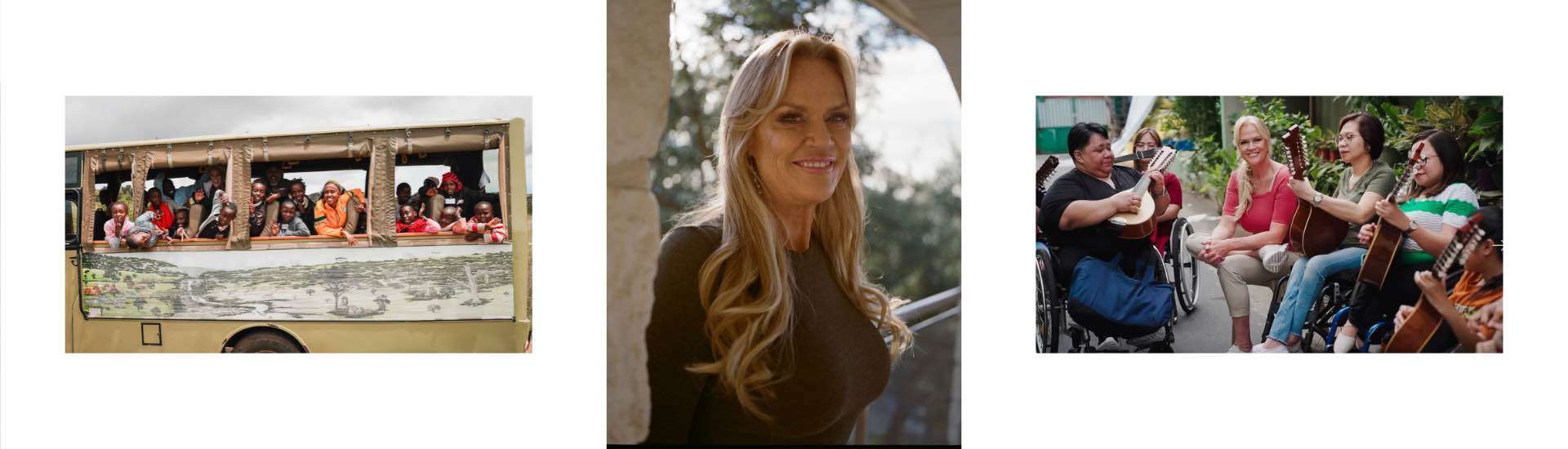
The sheer operational scope of what her foundation backs is immense. In Meru, Kenya, her foundation funded Light on a Hill, a community centre providing after-school creative spaces and agricultural training for children, where Rapier personally stepped in with supplementary funding when skyrocketing construction costs threatened the building's vital solar power installation. "To finish what you start," she noted simply, "is very important." That same meticulous dedication stretches across Uganda, Rwanda, and Liberia through music-education initiatives like Brass for Africa, and down to Matemwe, Zanzibar, where she funds Under the Wave to protect the coral reefs shaping daily coastal life. Back home, her scholarship programs follow students all the way from primary school through college.
It is a patient, high-stakes, long-haul model that demands institutional memory and an appetite for outcomes that cannot be captured in a superficial year-end report.
The Art of Listening and the Power of Storytelling
Perhaps the most potent element of Rapier’s worldview is her absolute humility regarding outsider intervention, a strict operating code built on the understanding that real aid cannot exist without empathy, is anchored entirely in trust, and requires you to listen long before you ever act, honouring the voices of the people who invite you into their stories.
"When people go to help another country, they go in thinking they hold all the answers without ever stopping to ask what is actually required," she reflected. "Our lives are completely different, so you can’t just impose a solution from the outside."
This principle guides not just her grant-making, but her approach to documentary storytelling, a core pillar formally embraced by the foundation in 2024. Operating with an in-house production crew, Rapier uses cinematic media to bring the human realities behind global statistics to wider audiences. "When you look at a piece of paper and see statistics, it's just numbers," she explained. "But when you actually sit down with people, hear their stories, find out what they truly need and share that with the outside world, that story travels."
Crucially, the communities featured in these documentaries retain editorial review before publication. "They approve it, they love it, they use it on their social media for them to get other donors," she pointed out. The finished films serve a dual purpose: they humanise the struggle for international viewers, and they double as professional amplification tools for local grassroots groups to attract their own independent donors.
Toward Generational Change
As our conversation wound down under the southern sun, wrapped in laughter about the formidable spice levels of Sri Lankan dhal and the physical toll of a three-and-a-half-week international circuit, I asked Rapier for her ultimate definition of success.
"We want to see generational change," she said. "When you plant the seed, and you water it and watch it grow, you want to see that continue forever, and only grow further."
In a culture that frequently rewards the loud announcement of a project over the quiet discipline of sustaining it, Kym Rapier offers a masterclass in active empathy. She reminds us of a fundamental truth: true philanthropy isn't about how much money you drop from the sky. It is about how closely you listen, how long you stay, and whether you leave a community strong enough to write its own future long after you've caught your flight home.
To support and to learn more about the foundation's global initiatives, or to explore their in-house documentary projects, visit:
Website: kymrapierfoundation.org
Instagram: @kymrapierfoundation
YouTube: Kym Rapier Foundation YouTube Channel





0 Comments