May 12 2026.
views 268By Gayantha Perera
Fashion loves to sell the fantasy of originality, but its most enduring silhouettes come from the world’s oldest uniforms — garments built not for aesthetics, but for authority. Priestly robes, military attire, and colonial‑era uniforms continue to reoccur on the runway because they were designed with a clarity fashion still envies: to signal power, hierarchy, and belonging.
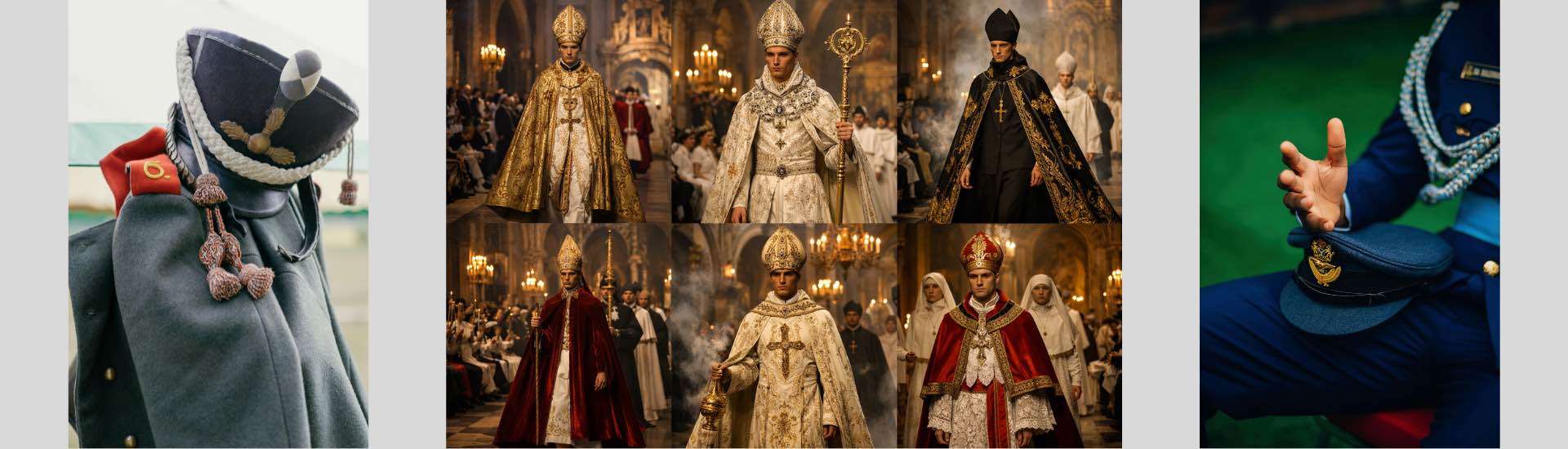
Last year’s Gucci Alta Moda in Rome made this lineage impossible to ignore. It wasn’t just a couture show; it was a pilgrimage through the visual language of ecclesiastical dress. And it proved, once again, that fashion’s most persistent inspirations are the uniforms we once feared, obeyed, or worshipped.
This relationship between uniform and identity surfaced again when Mayo College — one of India’s most storied boarding schools — celebrated its 150th anniversary. Distinguished alumnus Ritwik Khanna designed a special menswear collection crafted entirely from repurposed school uniforms. It was a rare moment when a uniform was not just referenced but literally transformed — a commentary on how deeply these garments shape the men who wear them, and how they continue to influence contemporary aesthetics long after their original purpose fades.
The first couture: Origin of menswear today
Priestly vestments were, in many ways, the first couture. Long before ateliers existed, religious institutions understood the visual theatre of clothing. Vestments were architectural, symbolic, and meticulously crafted — garments designed to elevate the wearer above the congregation. At Alta Moda, Gucci leaned directly into this sacred vocabulary. Models moved through Roman architecture like clergy, draped in papal‑scale capes, high monastic collars, and goldwork embroidery that echoed liturgical iconography. It was not parody. It was a recognition that ecclesiastical dress has always been fashion’s original spectacle — a system that mastered the art of awe centuries before the runway existed.
If priests gave fashion its drama, the military gave it its structure. Modern menswear is essentially a softened archive of military invention: the trench coat from WWI officers, the bomber jacket from aviation gear, the double‑breasted blazer from naval dress. Even the beloved Ghurka pants, now a global menswear staple, originate from the Gorkha regiments of the British Indian Army. Their high waist, double pleats, and wrap‑belt closure were engineered for mobility in the South Asian heat — a garment born from colonial militarism that now signals taste, worldliness, and a certain rugged refinement. Menswear’s obsession with authority, utility, and identity keeps these silhouettes alive; the uniform, even in civilian form, remains a psychological anchor.
The Power of Uniformity
South Asia, in particular, understands the power of uniforms because it has lived under so many systems where clothing was a tool of order. Temple priests in saffron robes created some of the earliest examples of color‑coded hierarchy. Mughal courts perfected ceremonial layering, jeweled insignia, and turbans that communicated rank with exquisite subtlety. Colonial rule introduced regimental jackets, drill fabrics, and school uniforms — the latter becoming a cultural norm across the subcontinent, embedding discipline and class signalling into daily life. The region’s fashion history is a palimpsest of ritual, empire, and adaptation.
Uniforms exist because societies need visual systems to make themselves legible. They tell us who leads, who serves, who protects, who prays, who belongs, and who doesn’t. They reduce ambiguity. They create hierarchy. They enforce cohesion. Fashion, ironically, uses uniforms to do the opposite — to stand out — but the psychological charge remains. A cape still feels ceremonial. A double‑breasted jacket still feels authoritative. A pair of Ghurka pants still carries the ghost of the empire. Designers return to uniforms because they offer something fashion alone cannot invent: instant meaning.
Why uniforms exist
The cycle is predictable and endless. Institutions create uniforms to project power. Fashion absorbs them, exaggerates them, or subverts them. The public adopts them, often unaware of their origins. Then designers revive them again, each time with new symbolism. Gucci’s Alta Moda in Rome was simply the latest turn of this wheel — a couture house re‑sanctifying religious dress for a modern audience, proving that vestments and uniforms remain some of the most potent visual languages we have.
In the end, fashion keeps returning to these garments because they were built with intention — the very thing fashion tries to manufacture every season. Uniforms are not relics. They are templates. They remind us that clothing is never neutral. It always signals power, devotion, discipline, or desire. And perhaps that is why fashion, for all its reinvention, still dresses like a priest, a soldier, or a student: these are the archetypes that taught us how clothing can transform a person into a symbol.








0 Comments