Apr 24 2026.
views 17By Paul Topping
I am particularly reminded at this time of the year of 11,500 Australians and New Zealanders who died on the battlefields of Gallipoli, Turkey, in 1915. It is at this time, 25 th April, that many families remember most their lost family members from the two World Wars. It is ANZAC Day, remembrance day for the Australian and New Zealand Army Corps. Sad to think how many wars are going on in the world today. It is as though we have not learnt anything. History repeating itself.
My first attendance at an ANZAC memorial was in Sydney, Martin Place, twenty-five years ago, and I revisited the site six weeks ago.
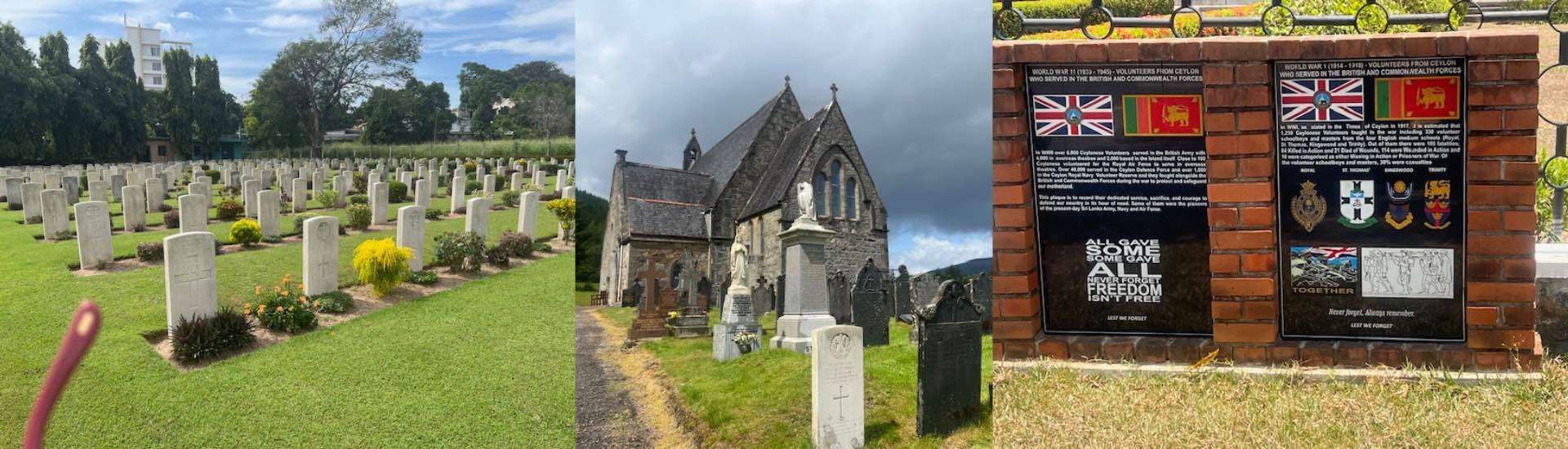
On a trip to Trincomalee last wee,k seven of us walked the Commonwealth graves to remember those who gave their lives so we could have a better future.
I was amazed that two youngsters in our group, both girls, were fascinated with the tour and asked lots of questions. I think learning from this type of experience should be given to all school children.
You can also visit Commonwealth graves in Colombo and Kandy, which are considered to be one of the most scenic of all sites globally. Many other military grave stones can be viewed in general cemeteries around the island, e.g., Muslim and church cemeteries. There are two thousand Commonwealth graves in Sri Lanka. Some tombstones have no bodies buried close by, and some bodies were never found/recovered. The cemeteries cover two world wars and multiple nationalities.
A friend of mine sent me a photograph of one of his relatives who was killed by a sniper on the first day of the Gallipoli, Turkey invasion in April 1915 by the joint forces. The photo of Blair Inskip Swannell shows him sitting on a rock with two other soldiers. One is Captain Alfred John Shout, who was awarded the Victoria Cross for his actions in the first battle of Gallipoli. Alfred, the most decorated Aussie soldier, after a string of heroic attacks on the Turks, died on the hospital ship returning home. His memorial grave stone lies locally in Baby700 cemetery, Gallipoli. It’s on my tapophile bucket list to visit.
I have a fascination with the Gallipoli campaign, a complete blunder by the then Minister of War, Winston Churchill.
The Gallipoli Peninsula was made famous by its futile loss of life, both of the Allied troops and the Turks. Two thousand Allied troops died in one day.
On a trip to New Zealand, I went to the waterfront for an ANZAC remembrance service. Each child had to shout out the name of the fallen soldier whose headstone they were standing behind. Again, I found this quite moving.
In Sri Lanka, I went to the ANZAC service only to find myself standing next to a rather scruffy chap with a large white beard, dressed in a pair of shorts. I started to make conversation, only to see on his chest a row of military medals. It turned out he was an Australian who had served in the Korean War. He was sailing his 40 foot catamaran around Asia. I asked where his family were, only to find he was sailing single-handed. I later took this colourful character to the British High Commission's home for a drop of wine, scones and lots of chat.
To get a sense of Gallipoli and what took place, watch "The Water Diviner", a 2013 film based on true events. An Australian farmer goes to Gallipoli to find his three sons who were in the battle. He assumes they have been killed, but no bodies have been found. He intends to find them and bring them back to be buried with their mother in Australia.
The founder of the Republic of Turkey said, “Your sons are now lying in our bosom and are at peace. After having lost their lives on this land, they have become our sons as well.”
We should not just remember them on ANZAC Day.










0 Comments