Sep 25 2026.
views 23By Tina Edward Gunawardhana
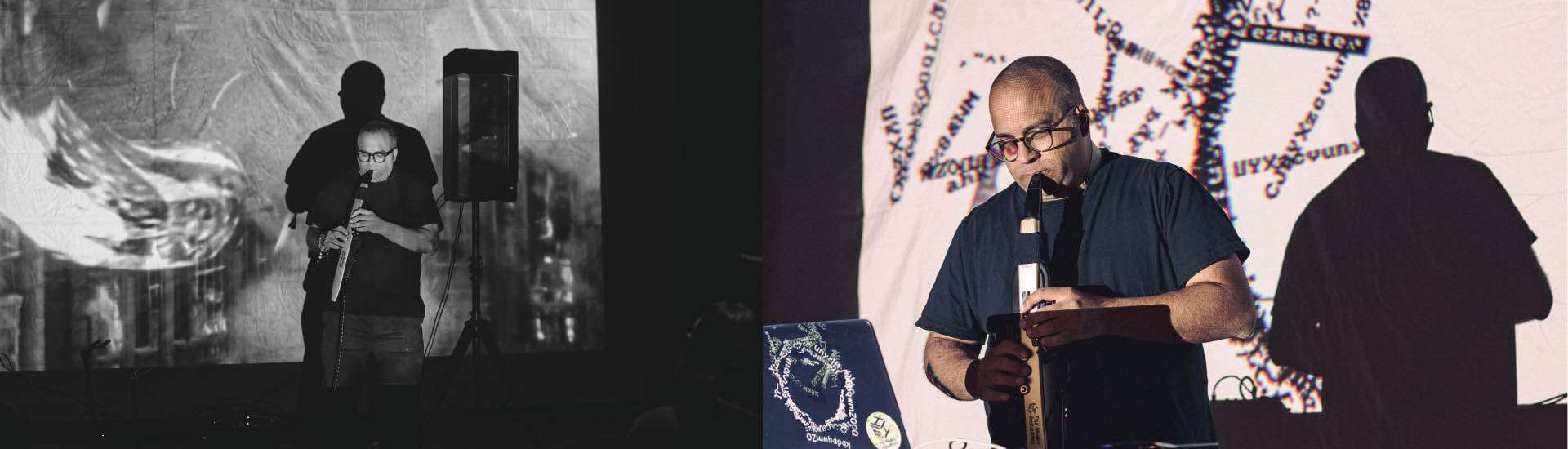
British Sri Lankan Software engineer, composer, improviser and instrument-builder Jon Philpott is creating a distinctive musical world where bamboo flutes, wind synthesis, trombone, electronics and improvisation converge.
For Jon Philpott, music has always been about exploration. What began more than two decades ago with a trombone and a passion for ska has evolved into an experimental practice that brings together acoustic instruments, technology and the improvisational traditions of Hindustani classical music.
“I started more than 20 years ago by learning the trombone and playing in a ska band in England,” he recalls. “Later on I started experimenting with electronic instruments, and in the last five years I finally had the idea to try and combine these worlds.”
His musical curiosity was shaped in part by his British-Sri Lankan upbringing. His parents were enthusiastic music lovers, meaning there was almost always music playing at home. Yet it was ska that particularly resonated with him.
A defining moment came in the late 1990s when he saw Asian Dub Foundation on British television. The London-based group’s fusion of electronic music and South Asian sounds opened up a new possibility for Philpott.
“It was the first time I ever saw South Asians on British TV doing something ‘cool’ and not the stereotypical shopkeepers seen in soap operas,” he says.
That spirit of crossing boundaries has remained central to his own work. With a background in computer programming dating back to his early teens, Philpott began developing software that could become part of his performances. Wanting to move beyond the image of “a man with a laptop on a stage”, he began building elaborate custom computers housed in wooden boxes, covered with interactive LED lights and switches.
His sound has since developed into an unusual meeting point between the organic and the electronic. Inspired by musicians including Japanese trumpet player Toshinori Kondo and Miles Davis, he became interested in combining wind instruments with electronic music. Hindustani classical fusion recordings, including Charanjit Singh’s Ten Ragas to a Disco Beat and Indo-Jazz collaborations, further influenced his direction.
The bamboo flute became an important part of this journey. Portable and quieter than a trombone, it offered a completely different sonic character.
“What I enjoy about the bamboo flute is that it is almost the antithesis of electronic instruments,” he explains. “Simply a piece of wood with holes in it. It has a sound that is very natural and ultimately human-controlled.”
He now also uses a wind synthesiser, allowing him to generate electronic sounds through his breath, further blurring the line between acoustic and electronic performance.
Improvisation is at the heart of his practice. Rather than following a rigid composition, Philpott establishes parameters such as a particular key or scale and allows the music to evolve organically. His approach is influenced by his fascination with dynamic systems in the software world, where rules are established, and systems are allowed to develop, evolve and disappear.
This idea of impermanence has become particularly significant. His custom-built software creates dozens of virtual tape machines, each with tapes of varying lengths. Sounds recorded during a performance loop back, but gradually degrade, becoming quieter and noisier until they disappear.
The technology has become a musical expression of Buddhist concepts of impermanence, emptiness and non-self. For Philpott, the sounds are never permanent possessions; they arise, transform and fade away.
“I have to constantly keep moving or simply allow them to fade away,” he says. Silence is equally important. In improvisation, he believes it is easy to allow an idea to continue indefinitely. Instead, he consciously leaves space, treating silence as another form of musical punctuation.
Based in Salt Lake City, Utah, Philpott has found a supportive musical community and hosts a monthly event with fellow musician Dante Lerae showcasing local artists and their projects. His performances are less conventional concerts than journeys, with Philpott responding to the atmosphere of the room and taking audiences somewhere unexpected.
One memorable performance at Salt Lake City’s International Artists Lounge ended with the entire bar falling silent during his flute performance. “I thought people had actually left!” he laughs.
Now, he is bringing this distinctive sonic world to Sri Lanka for a performance at The Sound Room. He hopes to offer audiences something different, yet ultimately familiar, while reconnecting with the country’s musical community.
And how does he describe his music? “Nostalgia for something you weren’t there for, a feeling of déjà vu for something you don’t remember experiencing.”
Jon Philpott will be performing at The Sound Room on 29th September 2026 from 6.30 pm. For tickets, call 071 1778435











0 Comments