May 05 2026.
views 2594By Gayantha Perera
Across South Asia, clothing has always been a cultural language. But in Sri Lanka, that language is especially coded - a mix of ancient modesty, colonial hangovers, class signaling, and a deep, almost primal desire not to offend anyone. The result is a fashion identity that is both uniquely ours and quietly conflicted.
Sri Lankans have an extraordinary relationship with clothing. We don’t simply get dressed; we curate a public version of ourselves that can survive the scrutiny of aunties, uncles, colleagues, neighbours, and the occasional stranger who feels entitled to comment. In this country, stepping out the door is a social act, and our wardrobes are the script.
The Saree: Our Most Elegant Contradiction
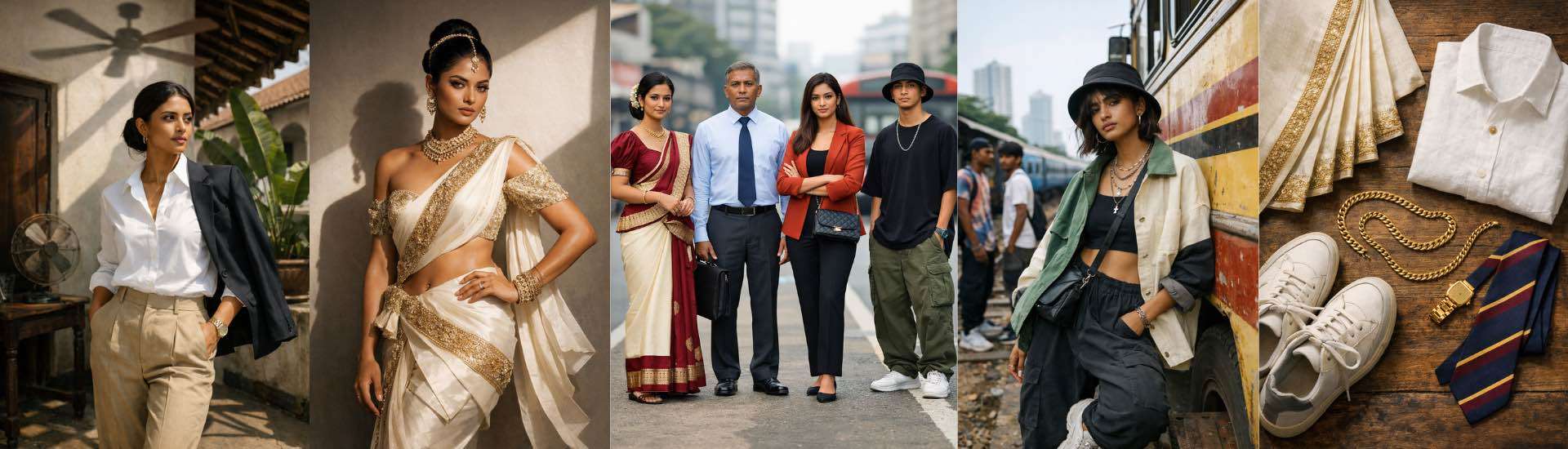
Take the saree. It is the national symbol of respectability, discipline, and properness. It is also, if we’re being honest, one of the most revealing garments we own. Yet nobody clutches their pearls over a low‑draped Kandyan saree. Why? Because tradition sanitizes exposure.
As sociologist Kanchana Ruwanpura notes in her work on South Asian dress norms, traditional garments are treated as “morally neutral,” even when they show more skin than Western clothing. This is the Sri Lankan paradox in a nutshell: exposure is acceptable when it’s historical, but scandalous when it’s modern. A crop top is rebellion. A bare midriff in a saree is culture.
We Dress to Belong, Not to Express
In a collectivist society, individuality is a luxury. Clothing becomes a tool for social survival. We dress to blend in, to avoid judgment, to signal that we understand the unspoken rules.
A 2021 study on Sri Lankan fashion psychology (Perera & Fernando) found that social expectations are one of the strongest motivators for clothing choices, especially among women. This is not surprising. In Sri Lanka, clothing is a public negotiation:
The Colonial Closet We Still Live In
We like to think we’ve moved on from colonial influence, but our wardrobes tell a different story. The office shirt, the school uniform, the blazer - all British imports we’ve absorbed without question. Yet we’ve adapted them to our climate and temperament: sleeves rolled, buttons undone, fabrics swapped for survival.
Fashion historian Nira Wickramasinghe has written extensively about this hybridization - the way Sri Lankans blend Western silhouettes with local logic. It’s not imitation; it’s appropriation with purpose.
Gen Z Is Quietly Rewriting the Rules
Then there’s the new generation - the first cohort dressing primarily for themselves. Oversized silhouettes, thrift culture, gender‑fluid styling, streetwear: these aren’t Western imports anymore; they’re identity tools.
A 2022 study on South Asian youth fashion found that psychological motivations - mood, creativity, self‑expression - now outweigh cultural or socio‑economic factors. That’s a tectonic shift. Clothing is becoming a personal narrative, not a public performance.
But even then, the Sri Lankan filter remains. A crop top is fine - but maybe only in certain parts of Colombo. A nose ring is cool - but maybe remove it before visiting your hometown. Modernity is embraced, but selectively.
So Why Do We Dress the Way We Do?
Because clothing is our quiet social contract. It’s how we say: I understand the rules. I respect the moment. I know who’s watching, and sometimes, I choose to break the script. Sri Lankan fashion isn’t confused. It’s layered. It’s strategic. It’s a negotiation between who we are, who we were taught to be, and who we’re slowly becoming. And maybe that’s the most honest thing about us.
In the end, Sri Lankans don’t dress by accident; we dress with intention. Every pleat, every sleeve, every silhouette is a quiet negotiation between who we are and who we’re becoming. My job is simply to help us make that negotiation look effortless. Because style, in this country, isn’t just aesthetic, it’s cultural literacy. It’s knowing when to honor tradition, when to challenge it, and when to rewrite the rules entirely. And if I’ve learned anything from dressing clients over the years, it’s that Sri Lankans are at our best when we stop apologizing for our complexity and start dressing with the confidence our stories deserve.








2 Comments
Hasitha says:
May 07, 2026 at 03:23 pmWhat is described as 'Traditional Kandyan Saree' here is not the actual traditional one. Look at very old black and white photos of real Nilames and their families. Do you see any ladies exposing their midriff? Their blouse hem is quite longer. Somewhere down the line someone changed the blouse to be more 'fashionable' with mostly open back and deep neckline often to show even the cleavage and that has become the norm now.
Dilkie says:
May 25, 2026 at 09:32 pmSrilankans dress to impress, and overdress. Over spend on cloths for weddings, parties etc. GenZ is. rewriting the rules.