
Sep 01 2026.
views 23By Rihaab Mowlana
When I used to teach social psychology, one of the first things we would unpack was how ordinary people manage to live with terrible contradictions. The human brain naturally hates friction. When the way you act collides directly with who you pretend to be, it creates an unbearable internal noise. Psychologists call that cognitive dissonance. But here is the thing about cognitive dissonance: it rarely makes people stop doing bad things. More often than not, it just forces them to get incredibly good at mental gymnastics.
If your actions conflict with your self-image, you have two choices: you either change your behavior, or you rewrite the narrative so you can keep doing it without feeling like a monster.
When you look at the massive online abuse networks currently exposing Sri Lankan households, the men involved are not stopping. They are running full-tilt through those mental gymnastics every single day.
Over the past few weeks, public outrage has exploded over local online groups where men openly post, swap, and solicit non-consensual images. But if you look past the initial shock value, the most horrifying part of this wave isn't the existence of internet predators. We already know the internet is crawling with them. The real horror of this specific crisis is who is holding the camera.
These photos are not being scraped from random adult sites or pulled off public Instagram profiles of strangers. They are being taken inside Sri Lankan living rooms, bedrooms, and kitchens. They are being uploaded by brothers, uncles, fathers, and sons, targeting their own mothers, sisters, and underage relatives.
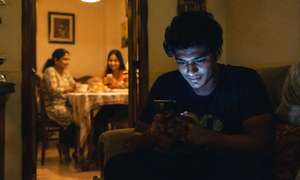
Think about the psychological mechanics of that for a second. How does a man sit across from his sister at dinner, pass her the rice, ask her about her day, and then go into the next room, open an app, and trade a photo of her sleeping to a group of five thousand strangers?
He does it through a process called moral disengagement - which is essentially the art of turning off your own conscience. He constructs a series of mental loopholes that strip the act of its real-world weight. He tells himself: She’ll never find out, so it’s not actually hurting her. It’s just pixels on a screen. It’s not real life. It’s just a game we’re playing in the group. The moment he frames a living, breathing human being as just data, the guilt evaporates.
The Architecture of the Funnel
This isn't happening by accident. It is an organized, step-by-step pipeline designed to break down a man's boundaries until he does things he might have found unthinkable six months prior.
It almost always starts on mainstream platforms like Facebook. Public and semi-public groups act as the top of the recruitment funnel. These are spaces where misogynistic memes, off-colour jokes, and casual boundary-crossing are normalised under the guise of banter. Men test the waters. They drop a comment, see who agrees, and realise they aren't alone.
Once mutual trust in this low-level depravity is established, the real operation shifts off public feeds. The conversation migrates into encrypted channels on Telegram, WhatsApp, or private cloud storage drives. And this is where the environment changes completely.
Psychologists talk about the online disinhibition effect - the way a glowing screen acts like a psychological cloak. When you enter an anonymous, encrypted space, your real-world identity stays at the door. You stop viewing yourself as a son, a brother, or a professional with a reputation to lose. You become a handle. In that space, real-world rules feel abstract, almost fictional.
Inside these closed channels, the economy is strictly "give-to-get." Access isn't free. To unlock the higher-tier folders, get access to exclusive drives, or earn admin status, you have to contribute fresh material.
This is where group polarization kicks in. When a group of people who share the same toxic bias gather without any outside voice to check them, they don't stay at a baseline. They push each other to further and further extremes. Downloading a photo off a stranger's profile doesn't earn you respect in those channels anymore; everyone has done that. To get real status, to prove you're really part of the brotherhood, you have to raise the stakes.
So, men look around their own homes. They wait for a sister to fall asleep studying. They capture a mother walking past a doorway in a moment of unguarded vulnerability. Through complete objectification, the woman living under the same roof stops being a family member with a fundamental right to safety. She is reduced to social currency - a token paid to buy validation from a room full of anonymous men.
The Silent Majority and the Myth of Culture
Then there are the men who don't post anything at all.
Every time one of these groups is exposed, you see member counts in the thousands, while the active posters might only be a few dozen. The immediate defense is always: "I was just in the group, I didn't post anything."
In social psychology, we call this pluralistic ignorance. When a person sits in a group and watches extreme, harmful behaviour happen without anyone speaking up, they privately assume that everyone else is fine with it. The silence of the crowd acts as powerful social proof. To the predator posting the image, every single silent member who lurks, views, or stays in that chat is offering tacit approval. The lurkers aren't passive bystanders; they are the audience. They are the infrastructure that makes the entire mechanism function. Without the crowd watching, the currency loses its value.
What makes this whole system so resilient in Sri Lanka specifically is how neatly it hides behind our cultural hypocrisy.
As a society, we expend an unbelievable amount of energy policing women. We lecture young girls on modesty. We tell them how to sit, how to dress, what time to come home, and how to behave online. We place the entire weight of a family's honour squarely on the shoulders of its women. We run public moral panics over the most trivial things, wringing our hands over public decency and traditional values.
Yet, when horrifying depravity takes root inside the domestic sphere, the culture suddenly goes stone deaf. A protective, shameful silence descends over the institution of the family. We would rather pretend it isn't happening than admit that the sacred Sri Lankan household is, for many women, the most unpoliced danger zone they step into every day.
We tell women to be careful on the internet, to set their accounts to private, and to watch out for strangers. But how do you lock your profile against the person who lives in the bedroom across the hall? How do you protect your digital safety when the threat has physical access to your living room while you sleep?
Why Real Accountability Starts at Home
It is easy to look at this crisis and demand simple fixes. And yes, those fixes are urgent.
Sri Lanka’s legal framework is woefully outdated. The Computer Crime Act needs radical revision to explicitly recognize and criminalize the digital facilitation of non-consensual image trading and domestic predation. The National Child Protection Authority (NCPA) needs genuine structural independence so it can actively monitor and investigate these networks rather than sitting by a phone waiting for victimized families to report crimes they are often too terrified to speak of. Tech platforms like Meta must be held accountable for the sheer incompetence of their moderation systems in local languages.
But we have to be honest with ourselves: no law, no court backlog clearance, and no algorithm update is going to fix what is happening inside human minds behind closed doors.
Legislation deals with the aftermath of harm. It doesn't undo the psychological shift that allowed a man to view his own family as tradeable material in the first place.
Until we are willing to strip away the comfortable lie that domestic violence only looks like a raised fist, this rot will continue to spread. It looks like a phone camera tilted toward an open doorway. It looks like a Telegram notification lighting up in the middle of the night. It looks like a brother trading his sister's dignity for a burst of dopamine and an online thumbs-up.
We need to stop treating this as an "internet problem" or a failure of female digital literacy. Women didn't create this danger, and no amount of privacy settings will save them from it. This is a crisis of male accountability, male radicalization, and the quiet collapse of domestic trust.
The danger is not an anonymous hacker sitting thousands of miles away. The danger is already inside the house, sitting at your dinner table, plugged into the wall, and charging in the next room.











0 Comments