Jan 14 2026.
views 198
17–18 January 2026 | Colombo, Sri Lanka
Exhibition open: 18 January – 15 February 2026
Venue: 138 Galle Road, Colombo 3
TAKE on Art × KALĀ returns this January as a cross-border contemporary arts platform, bringing together leading artists, curators, scholars, and cultural practitioners from across South Asia. Taking place over the opening weekend of 17–18 January 2026, with the exhibition open to the public until 15 February 2026, the programme positions Colombo as a vital site for regional artistic exchange.
Presented by TAKE on Art magazine in collaboration with KALĀ South Asia, KALĀ 2026 brings together exhibitions, live performance, workshops, curated walkthroughs, and public conversations that explore memory, materiality, reconciliation, and contemporary artistic practice across South Asia and its diasporas.
Exhibition title
Shared Ground: South Asia in Conversation
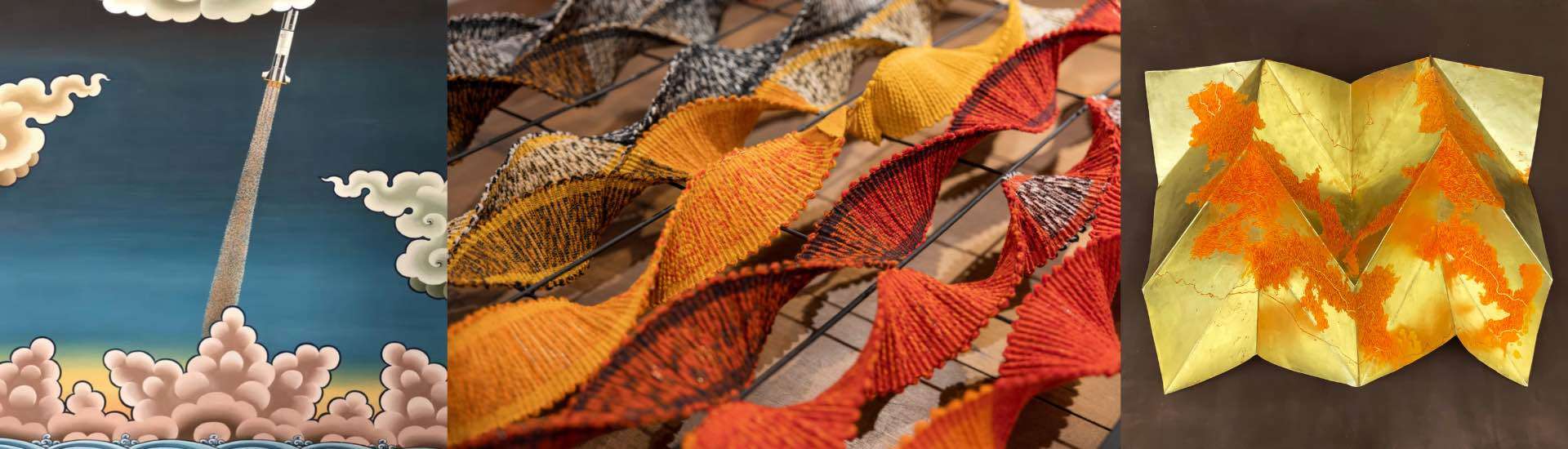
At the heart of KALĀ 2026 is Shared Ground: South Asia in Conversation, an exhibition that approaches South Asia as a lived, material, and relational space rather than a fixed identity. Across painting, drawing, textile, and installation, the exhibition foregrounds material as a carrier of memory, labour, belief, and consequence—inviting viewers to consider how meaning is shaped when practices are placed in relation.
Curatorial text by Tanya Dutt.
Exhibiting Artists
The exhibition features established and mid-career artists whose practices are internationally recognised and deeply rooted in socio-political, post-colonial, ecological, and material research:
· Ahmed Rasel (Bangladesh)
· Eagan Badeeu (Maldives)
· Farhat Ali (Pakistan)
· Firi Rahman (Sri Lanka)
· Gopa Trivedi (India)
· Khadim Ali (Afghanistan)
· Kiran Maharjan (Nepal)
· Kishwar Kiani (Pakistan)
· Phurba Namgay (Bhutan)
· Tashi Lama (Nepal)
· Vibha Galhotra (India)
· Marie Gnanaraja (Sri Lanka)
Together, the artists represent Pakistan, India, Afghanistan, Bangladesh, Nepal, Bhutan, the Maldives, and Sri Lanka, situating Colombo firmly within an active South Asian artistic circuit.
Friday, 17 January 2026
Workshop | 11:00 am – 3:00 pm
Of Mirage and Mirror: Passage on Photography
A photography and writing workshop led by Dilpreet Bhullar (India), focusing on image-making, narrative, and authorship.
WORKSHOP: OF MIRAGE AND MIRROR: PASSAGE ON PHOTOGRAPHY
3 hours (inclusive of a 1 hour lunch break at the café)
Photography workshop led by Dilpreet Bhullar (India)
A focused engagement on image-making, narrative, and authorship.
The workshop of Mirage and Mirror: Passage on Photography is conceived as a critical pedagogical framework to develop visual literacy, analytical precision and reflective modes of writing about photography. It foregrounds photographs as cultural texts that actively participate in the construction of meaning, public memory and historical consciousness. Particular emphasis is placed on the role of language in mediating photographic meaning, both as a tool for interpretation and contestation.
The workshop introduces participants to the foundational theoretical texts by key thinkers, including Roland Barthes (Camera Lucida), Susan Sontag (On Photography), John Berger (Confabulation) and Ariella Azoulay (The Civil Contract of Photography). These readings provide a shared conceptual lattice and critical vocabulary through which participants can interrogate the politics and social life of photographs. Guided reading and structured discussion enable participants to examine how photographic meaning is produced, how images circulate within regimes of representation and how they are embedded within broader historical and ideological narratives.
Participants are also introduced to a range of writing genres, including academic essays, exhibition and book reviews, artist statements and reflective or personal texts: each understood as a distinct mode of response to the visual composition of the photographs. In a time of visual saturation and acceleration, the workshop insists on attentive slowness and critical pause. Participants are encouraged to consider what photographs reveal, but also what they obscure, exclude and/or normalise. Writing exercises are designed to cultivate precision in description, depth in interpretation and sensitivity to context. Of Mirage and Mirror: Passage on Photography prioritises creative process over final outcomes to translate visual encounters into a wider cultural enquiry: how photography shapes perception, memory and narrative.
· Open to professional writers, artists and anyone with an interest in writing;
· Participants from all disciplines and at any stage of their creative practice are welcome;
· Suitable for those interested in expanding a visual practice to include writing, both personal and professional;
· Participants are requested to bring a printed personal photograph of their choice (a non-iconic photograph not from the history of photography); and
· Writing cues and group writing sessions explore multiple ways of engaging with a photograph.
· Welcome cocktails
· Curatorial walkthrough with Tanya Dutt
· Live performance by Richi K. Bhatia (India / UAE)
A performative work engaging body, material, myth, and gender through sensory interaction, followed by an informal Q&A.
Saturday, 18 January 2026
PANEL 1: RIPPLE SAIL FOR RECONCILIATION
1 hour 15 mins (20 mins each panellist)
Followed by 10 mins Q&A
Moderator: Puja Vaish (India)
Panelists: Hasini Haputhanthri (Sri Lanka), Gopa Trivedi (India), Hamra Abbas (Pakistan), Pradeep Thalawatta (Sri Lanka)
The panel discussion Ripple Sail for Reconciliation sifts through the micro sensitivities of domestic space and personal histories to illuminate the pattern of reconciliation at the expanse of the macro landscape of South Asian and diasporic contexts, particularly. To sail through the ripple effect of the past in the present is to reimagine the future of history. By weaving insights from art, history, and lived experience, the conversation invites audiences to realign the past as a site of fecund narrative and cultural continuity.
Visual artist Pradeep Thalawatta works at the intersection of lived experience and socio-political commentary to draw upon personal narratives rooted in home, displacement and the sensory landscapes of memory. Through his multidisciplinary practice, he examines how domestic rituals and the textures of daily life encode collective storylines, offering viewers a way to reconsider the emotional architecture of home.
Gopa Trivedi, a visual artist whose practice draws heavily from traditional Indian knowledge systems, explores the fluidity between the tangible and the metaphysical. Working with drawing, natural pigments, and ecology-rooted processes, Trivedi probes the porous boundaries between body, landscape and cosmology. Her work reactivates inherited wisdom, whether botanical, artisanal or ritualistic, to question how knowledge travels, mutates and survives across generations. By foregrounding materiality and the rhythms of nature, she situates reconciliation as an embodied dialogue between past and present, reminding audiences that cultural memory can take root in pigments, gestures, and the embedded intelligence of traditional practices.
Hasini Haputhanthri, a cultural historian and memory practitioner, introduces a research-driven lens grounded in community engagement and critical heritage studies. Her work examines how personal and collective memories transpire in migration stories and intergenerational exchange, shape national and cultural narratives. She highlights archives with a ripple effect to anchor the evolving repository of identity, resilience and belonging.
Ripple Sail for Reconciliation, thereby probes: How do living traditions become vessels of heritage? In what ways do homes: lost, imagined, or reclaimed, shape creative and cultural expression? How can artistic practice help communities preserve, challenge or reinterpret their memories?
PANEL 2: CARRIERS OF CREATIVE FORCE
Moderator: Pujan Gandhi (India)
Panellists: Vibha Galhotra (India), Mayank Mansingh Kaul (India), Kailash K Shrestha (Nepal), Indira Kithsiri (Sri Lanka), Firi Rahman (Sri Lanka)
The panel Carrier of Creative Force is a confluence of textile history, art collection and contemporary public art to dig into materiality, memory and place for shaping South Asian creative force in contemporary times. Together, the panellists will discuss the evolving role of material heritage, the ethics and possibilities of collecting and the power of art to activate shared public space. They will reflect on how their individual practices respond to questions of identity, cultural memory, and transnational exchange, particularly within the broader South Asian and diasporic milieu.
Mayank Mansingh Kaul, a curator, designer, and writer known for his extensive work on Indian textiles and craft-based knowledge systems, offers a lens into how traditional practices can be contextualised within modern design and cultural narratives. His research underlines the layered histories embedded in fabric, technique and craft communities, prompting deeper questions about authorship, preservation and reinterpretation.
Joining him is Indira Kithsiri, a Swiss-Colombo collector whose cross-cultural approach to collecting emphasises the emotional, historical, and diasporic significance of objects. Her collection work is a conduit between Europe and South Asia, foregrounding how personal and institutional collecting can bridge identities, geographies, and artistic legacies. With a discerning eye for material culture and its capacity to carry stories, she brings a collector’s perspective to discussions of value, belonging and cultural stewardship.
Carriers of Creative Force will examine how contemporary creators negotiate global influences while grounding their work in local histories and community relationships. The act to interlocate curation, collection and public art is to consider the dynamic relationships between objects, makers and communities. It aims to elucidate how creativity nurtures and nourishes dialogue across borders and disciplines, and how art, whether held, worn, archived or encountered in public.





0 Comments