Nov 18 2026.
views 36Teardrop Nation: A Past We Cannot Forget, A Future We Must Protect
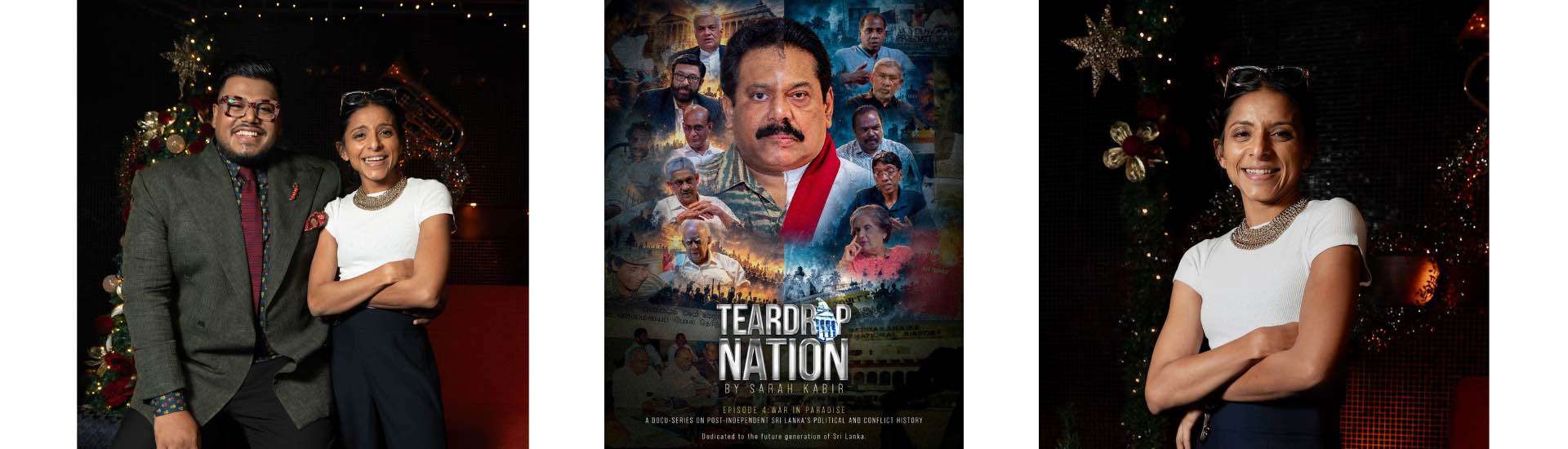
I was genuinely disappointed that I missed the official screening of Teardrop Nation, because this is one documentary I believe every Sri Lankan should watch. More importantly, it has started a conversation that our country desperately needs to have.
Sri Lanka is a beautiful nation, blessed with extraordinary people, cultures and traditions. Yet, for far too long, our country has been misguided, misled and divided by decisions that have left lasting scars on generations of Sri Lankans.
As someone who comes from Jaffna, whose own childhood was shaped by conflict and displacement, I know that the consequences of war are not simply stories written in history books. They are experiences that stay with people for a lifetime.
We need to embrace the uncomfortable truth that conflict only destroys lives, divides communities and takes a nation backwards. It is good governance, responsible leadership, informed decisions and mutual understanding that can truly move a country forward.
And perhaps our greatest responsibility today is to ensure that the younger generation understands the mistakes of the past. They must know what happened, why it happened and how those decisions affected the country they now call home. History should not simply be something we memorise for an examination. It should be something we learn from so that we never repeat its darkest chapters.
That is why I believe Teardrop Nation is such an important piece of work. It encourages us to question, listen, reflect and, most importantly, have conversations that we may have avoided for far too long.
My appreciation goes to Sarah Kabir and her entire team for the remarkable dedication behind this six-year journey.
Today, on Buzz with Danu, we get to know Sarah a little better, understand the challenges of bringing this documentary to life and explore why understanding our past may be one of the most important steps towards building a better Sri Lanka.
⸻
1. Sarah, Teardrop Nation has been a six-year journey. Take me back to the beginning. What made you feel that this was a story Sri Lanka needed to hear, and why did you feel you were the person to tell it?
By no means do I feel I was the right person to tell this story. But as it was not being done through the school education curriculum or at a more official level for the younger generation, I felt the need to record this before these stories were lost with time.
And these are not just stories. This is our history. Every Sri Lankan needs to know how we got here so that we do not repeat the same mistakes again.
A country that doesn’t know its history is most likely to repeat it, and ours is a history our country cannot afford to repeat.
2. Sri Lanka has a complicated history, and depending on whom you speak to, the same event can have very different interpretations. How did you navigate these conflicting narratives while trying to remain fair and truthful?
Whenever we picked a topic to discuss in the series, we were very strict about ensuring that we included opposing opinions on matters that were not established facts.
We had our research, the 33 official interviews we had conducted, and our collection of archives. We used these three sources, which sometimes supported each other and sometimes contradicted each other. Especially when including interviews, we made sure that as many perspectives as possible were covered.
Of course, I didn’t live through more than half of the decades this series covers, and I have tried to tell this story as best as I can through the eyes, minds and hearts of those who lived through it.
And I apologise to those whose experiences I may not have been able to capture.
3. Six years is a long time to dedicate to one documentary. Was there ever a moment when you felt emotionally exhausted, frightened or even tempted to walk away from the project?
No. When I set my mind to something, giving up is never an option. It is easy for all of us to come up with great ideas; executing them is the hard part. I can be tough on myself to ensure that whatever I set my mind to is seen through to the end.
But, of course, there were many times I felt exhausted and frightened, and I still do. Especially now that it is out in the open and subject to public scrutiny.
I hope people understand that this was made with the best intentions in mind: to help forge a better Sri Lanka.
I spent 20 years of my life in a country in conflict, and the next half through political turmoil after political turmoil, in a constant state of fear that something was about to erupt.
I believe Sri Lanka could be much better. I appreciate all the country has given me. My need to contribute something to my country helped me push through any feelings of exhaustion and fear.
4. When you started interviewing people and uncovering stories, was there anything that completely challenged what you had previously believed about Sri Lanka and its history?
Yes, there were many instances. Mostly, there were a lot of new things I learnt, which made me realise how little we really know.
There were many things, like the Vaddukoddai Resolution and the Citizenship Act, that made me realise it wasn’t just one factor that led to conflict. It was multiple things, all happening at the same time, which, in hindsight, also seem to have been avoidable.
A key thing that changed my opinion was how we place blame.
I, too, blamed many political parties and politicians for what had happened in Sri Lanka. But through Teardrop Nation, I also realised how we, as a society, were to blame.
It became increasingly apparent to me how we had all made mistakes. As they say, “When you point a finger outward, there are four pointing back.”
5. I come from Jaffna, and my own childhood was shaped by conflict and displacement. For people like me, these are not simply chapters in a history book. When you spoke to people who lived through the war, what were the stories that stayed with you long after the cameras stopped rolling?
I think, for me, one of the most significant stories was how those in the North felt hearing the South celebrate with firecrackers and kiribath after they had faced so much death and destruction.
There is also the archival footage of civilians crossing through Nandikadal that will never leave my mind.
I can’t believe these things happened in our country. I can’t believe that we did things that led to so much pain for so many Sri Lankans.
6. Do you think Sri Lankans have genuinely tried to understand what other communities experienced during the conflict, or have we become comfortable listening only to versions of history that support our own beliefs?
Unfortunately, the latter.
And I hope Teardrop Nation will help us open up our minds. It’s not that your version is wrong, but there are other versions too, which we must pay attention to.
7. There is a generation of young Sri Lankans who were born after the war ended in 2009. How much do you think they actually know about what happened, and what concerns you most about the way our history is being passed down?
They know very little, and I can say this with authority.
After conducting multiple surveys and focus groups, it was very clear how little the youth and schoolchildren knew about their own country’s history.
This is not their fault, but ours, for not teaching this in schools.
Furthermore, the way history is taught as being black and white is also not staying true to the concept of history.
8. When dealing with a subject as sensitive as Sri Lanka’s ethnic conflict, criticism is almost inevitable. Were you concerned about how different communities would respond to Teardrop Nation, and how did you prepare yourself for that?
Yes, I was very concerned. Honestly, I didn’t prepare for it, and I still haven’t. I might need to find a bunker and hide as more people watch it!
But jokes aside, I feel we have presented a well-balanced account. Our research process was extremely rigorous.
To date, there have been comments here and there questioning the veracity of certain things that people don’t want to believe are true.
For example, the fact that the Kandyans were the first to ask for federalism. There are multiple reports that support this.
So I hope people who question some of what is in the episodes dig a little deeper and do some research, if the episodes themselves don’t encourage them to challenge what they hold to be the truth.
9. There is a difference between remembering the past and remaining trapped in it. How do we encourage people to confront painful history without reopening divisions or creating new resentment?
By acknowledging our own personal actions.
It is not about finding fault with one another. When you watch the episodes, you will see how all political parties, all ethnic communities and all of us made mistakes.
If we take that in, the hope is that, in the future, when we see signs of discrimination that could lead to violence, we will be able to prevent it from happening again.
The purpose of this series is non-recurrence. And that is only possible by knowing what happened, however hard it might be to hear or see.
10. Do you believe there are uncomfortable truths that Sri Lankan society, across all communities, still refuses to acknowledge? And can we ever move forward without having those difficult conversations?
Yes, I sadly believe there are uncomfortable truths we still refuse to acknowledge.
And I personally feel we cannot move forward without having those difficult conversations.
Without an understanding, acknowledgement and acceptance of our past, we risk repeating the same cycles of discrimination and violence.
11. As a filmmaker, you have the power to influence how people understand history. How did you balance your responsibility to tell an honest story with the possibility that your documentary could provoke strong emotions or disagreement?
I stayed true to the research.
The docuseries is not my opinion in any way. I, too, didn’t know 90% of what is in there.
I am a trained researcher, and I stuck to what the research had to say and presented it as such in the docuseries.
All material has been rigorously fact-checked, and we used only authentic sources.
I believed it was important to keep my thoughts and feelings out of it, as I, too, didn’t know much and was open to learning, as I hope everyone who watches this will be.
12. If Teardrop Nation could be screened in every school and university in Sri Lanka, what is the one conversation you would want young people to have after watching it?
What should we be doing as citizens to ensure this doesn’t happen again?
I would also want them to have a burning urge to go and ask their older friends and family members what their experiences were.
To talk about these things over the dinner table with family and within their circles of friends. To question and constructively debate.
And to want to learn and read more of what has been written by the academics interviewed in the series and others.
13. Finally, Sarah, after six years of listening to stories of conflict, pain, survival and resilience, are you more hopeful about Sri Lanka’s future than when you began? And what would you say to a young Sri Lankan who wants to believe that we can truly become one nation?
I don’t know if I’m more hopeful as a result of the series. But I live in hope that this is possible.
To the younger generation, I would say: don’t underestimate the value of a citizen.
It is in each one of our hands to forge a better future.
And to know where you want to go, you must first know where you came from.







0 Comments